Genre: Lyric Essay, Dramatic Monologue
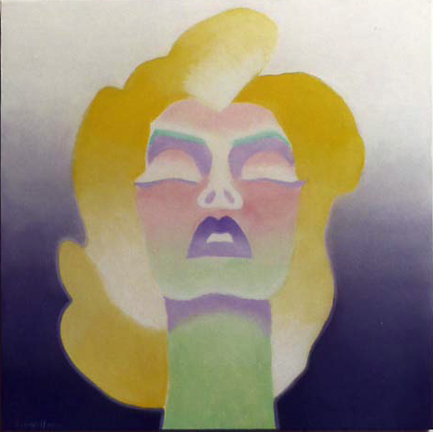
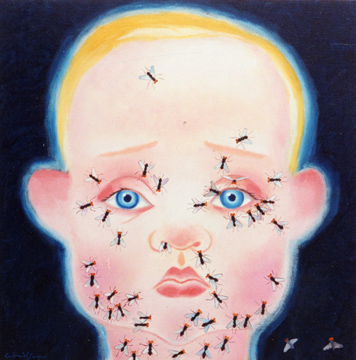
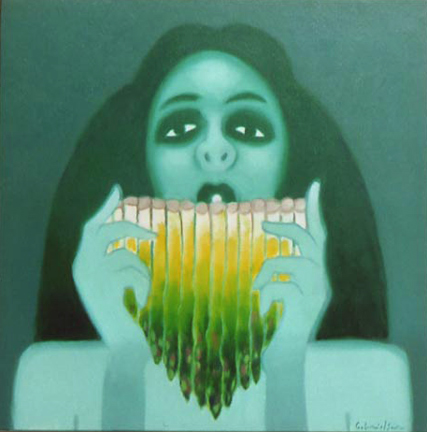
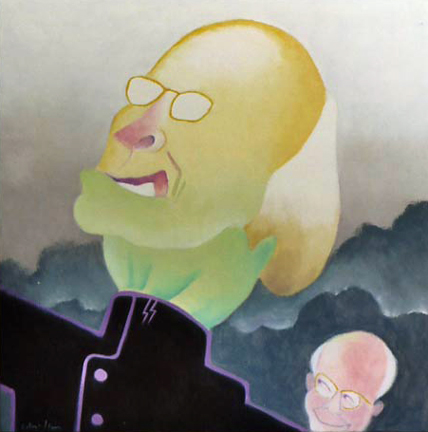
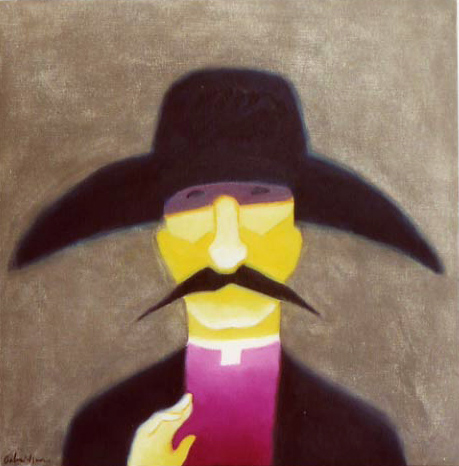
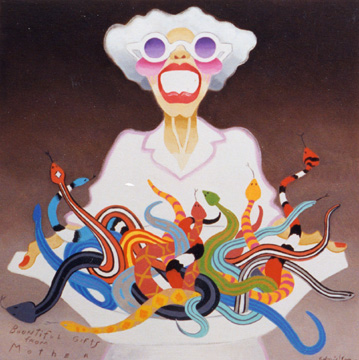
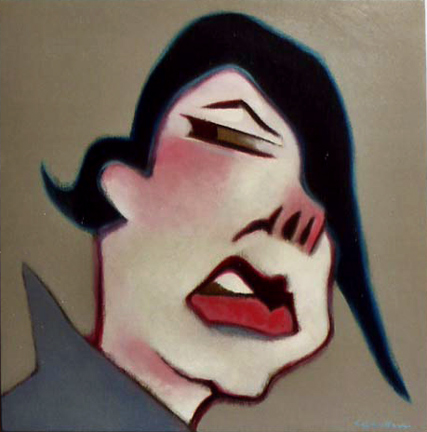
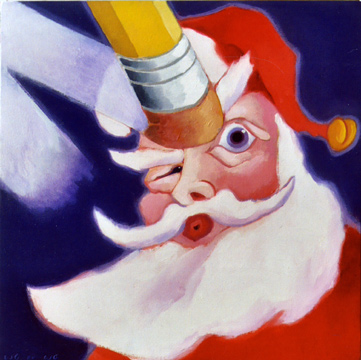
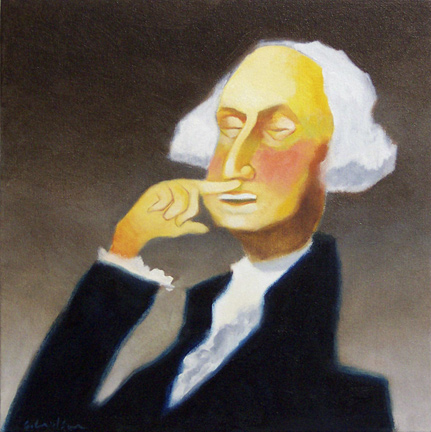
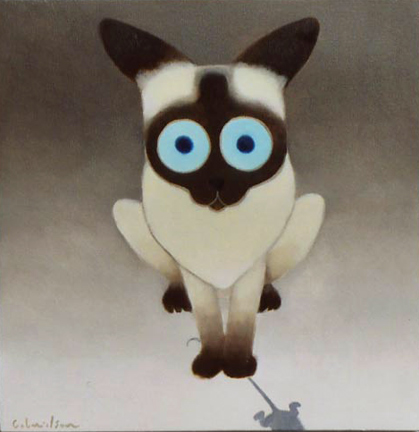
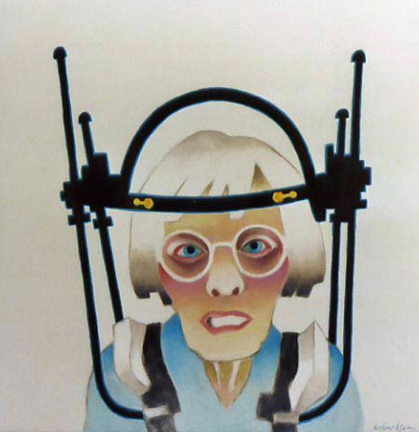
Illustrations by Walter Gabrielson
"She's a real mess. And a very bad mother I'm sure, that Anna Nicole. Very bad, indeed. So I don't know what everyone is crying about. Just look at her. What'll bring you to tears is when you see her kid, the poor thing. That child hasn't a chance. Well, not that anyone is doing a very good job these days, raising their kids, I mean. The kids on this block nowadays. They're starving! My kids, they may have grown into strange people - my little Sherry, for instance, she's all talk about veganism and gluten-free pumpernickel toast and asparagus. But when she was a girl, you bet as sure as Sunday dinner she was well-fed. We were a real family. Oh, we were as happy on Tuesday afternoon as we were on Saturday evening. And my husband, may he rest in peace, he was a good man. We used to take the kids to the movies. I'd get all dolled-up and look real nice. My husband would tell me 'Sandy, you're as perfect as a painting. You're a real woman with pearl earrings.' The kids would have on their nice clothes. We knew how to do things up. And on Sunday we went to church with a real pastor, not these 'spiritual healers' they talk about nowadays. We were good Catholics and we never heard a word about 'Scientology' or 'psychiatry.' We were just good hardworking people. Not anymore, not these kids. They don't stand a chance. Not with the way things are now - Pop Stars molesting kids right off the street. Did you know there's parents who don't even let their little one's celebrate Christmas? They're all talk about 'commercialism' and 'where our forefathers went wrong.' They all think they know better. All these ideas these young parents have today... But I don't say anything. Dean and I just sit on the front stoop and watch them go by. Because I had a good life, look at me. I'm as happy on Tuesday afternoon as I am on Saturday evening."


28.6.07
Neither House Nor Harbor
Genre: Lyric Essay

My mother’s kitchen is filled with smoke from bacon that is being cooked in heavy butter on a frying pan. She is outside calling at a dumb-brained dog that I brought home from the pound when I was sixteen without her permission. She is yelling at the dog from the back porch that overlooks the harbor. Upstairs is a twenty-five year old woman named Lilith who works at the local organic food coop. Lilith lays on her bed and rolls her eyes at the sound of my mother’s yelling. Below Lilith’s room is the kitchen. The kitchen is old and wooden with counter tops that slant downwards towards the floor, sagging with their age. My mother runs inside the house, the dog following behind her with a grin on his face and mud on his paws.
The smoke rises from the pan and drenches the lace curtains, which have slowly turned yellow. Sunday after Sunday my mother cooks bacon in the pan, which is black from Sunday after Sunday’s worth of butter and bacon being left too long to cook. Sunday after Sunday the lace curtains are drenched in the smoke from the bacon. My mother scuffles into the kitchen and grabs a blue-and-white-checkered cloth and swoops up the pan, landing it on the butchers block counter. The bacon continues to sizzle as the butter slides across the pan with the slope of the counter top.
My mother turns around and bumps into the dog. When she looks down at him she sees his muddy paws and begins squawking at the trail of prints he has left behind him on the pine floors. She shoos the dog back out the door, waving the cloth at him as he cringes at her squawking. She bends over and attaches him to a leash that is tied to a post that holds up the porch roof. The porch roof is also sagging with age. The entire house looks as though it is melting.
Inside is the dining room, which is next to the kitchen where the bacon has stopped sizzling but continues to smoke below the lace curtains. In the dining room there are piles of magazines that my mother reads on Sundays as she eats her bacon and biscuits. Three years worth of The New Yorker spill from the wooden bookshelf that sits next to a down-stuffed chair where my mother does her reading. My mother runs back inside, not noticing that the kitten that belongs to Lilith, the woman who lives in one of the house’s three bedrooms, has ran out the door and into the yard behind her. She goes back into the kitchen waving at the smoke with the blue-and-white-checkered cloth.
Billy Holiday’s voice bellows from the stereo in the dining room. The volume of the music drowns out the sound of knocking on the front door. As the song ends my mother hears the knocking and scuttles from the kitchen, through the dining room and into the living room where she sees Levi on the front porch. Levi lives in the second spare bedroom and he has forgotten his keys. Lilith comes downstairs when smoke from the bacon has crept up the stairs and fills her room. Lilith is a vegan and hates when my mother cooks bacon on Sundays. Levi storms past my mother, who is blocking the stairs and past Lilith who is coming down the stairs. He runs up the stairs to get his keys. He is late to get to work at the wood shop where he works restoring antique sailboats.
I am on the phone with my mother as all this happens. I have never been to see her house on Squirrel Island. She moved there three years ago and rents out her spare rooms to young people because she 'can’t live with too much silence.' I have spent the last ten minutes listening quietly from my bed in my loft, a converted warehouse in in Bushwick, where my roommates are either not home or still sleeping. There are three of us living here and I have not seen anyone in three days.
I am listening to my mother mutter cheerfully through the phone about how much she loves Sundays – about how much she loves having a house filled with people – about how the dog loves living by the harbor where he can go on walks without a leash – about how Levi is helping her find a sailboat to buy before the summer – about how Lilith hates when she cooks bacon – about how the kitten and the dog are getting along – about how the lace curtains in the kitchen are turning yellow – about everything, until the three of them, my mother, Lilith, and Levi, collide at the staircase, which is now filled with smoke from the bacon and butter.
Lilith asks where her kitten is. Levi yells from upstairs asking if anyone has seen his keys. My mother says she must get off the phone ‘Levi lost the kitten’ she says ‘and Judith can’t find her keys – oh, and I think the bacon is still on the stove.’ I try to engage in some sort of formal good-bye but find the line dead before I can speak the words. I hang up the phone an turn into my pillow which is yellow because of one summer's worth of sweat and my hatred towards the long, quiet walk to the laundromat. My neck is damp and hot, though the fan is directly beside me. It doesn't cool my neck, just moves the warm air of my room which has no windows to the outdoors, just two squares cut into the top of the wall which look into the living room. The living room windows look into an alleyway. The alleyway looks down.

My mother’s kitchen is filled with smoke from bacon that is being cooked in heavy butter on a frying pan. She is outside calling at a dumb-brained dog that I brought home from the pound when I was sixteen without her permission. She is yelling at the dog from the back porch that overlooks the harbor. Upstairs is a twenty-five year old woman named Lilith who works at the local organic food coop. Lilith lays on her bed and rolls her eyes at the sound of my mother’s yelling. Below Lilith’s room is the kitchen. The kitchen is old and wooden with counter tops that slant downwards towards the floor, sagging with their age. My mother runs inside the house, the dog following behind her with a grin on his face and mud on his paws.
The smoke rises from the pan and drenches the lace curtains, which have slowly turned yellow. Sunday after Sunday my mother cooks bacon in the pan, which is black from Sunday after Sunday’s worth of butter and bacon being left too long to cook. Sunday after Sunday the lace curtains are drenched in the smoke from the bacon. My mother scuffles into the kitchen and grabs a blue-and-white-checkered cloth and swoops up the pan, landing it on the butchers block counter. The bacon continues to sizzle as the butter slides across the pan with the slope of the counter top.
My mother turns around and bumps into the dog. When she looks down at him she sees his muddy paws and begins squawking at the trail of prints he has left behind him on the pine floors. She shoos the dog back out the door, waving the cloth at him as he cringes at her squawking. She bends over and attaches him to a leash that is tied to a post that holds up the porch roof. The porch roof is also sagging with age. The entire house looks as though it is melting.
Inside is the dining room, which is next to the kitchen where the bacon has stopped sizzling but continues to smoke below the lace curtains. In the dining room there are piles of magazines that my mother reads on Sundays as she eats her bacon and biscuits. Three years worth of The New Yorker spill from the wooden bookshelf that sits next to a down-stuffed chair where my mother does her reading. My mother runs back inside, not noticing that the kitten that belongs to Lilith, the woman who lives in one of the house’s three bedrooms, has ran out the door and into the yard behind her. She goes back into the kitchen waving at the smoke with the blue-and-white-checkered cloth.
Billy Holiday’s voice bellows from the stereo in the dining room. The volume of the music drowns out the sound of knocking on the front door. As the song ends my mother hears the knocking and scuttles from the kitchen, through the dining room and into the living room where she sees Levi on the front porch. Levi lives in the second spare bedroom and he has forgotten his keys. Lilith comes downstairs when smoke from the bacon has crept up the stairs and fills her room. Lilith is a vegan and hates when my mother cooks bacon on Sundays. Levi storms past my mother, who is blocking the stairs and past Lilith who is coming down the stairs. He runs up the stairs to get his keys. He is late to get to work at the wood shop where he works restoring antique sailboats.
I am on the phone with my mother as all this happens. I have never been to see her house on Squirrel Island. She moved there three years ago and rents out her spare rooms to young people because she 'can’t live with too much silence.' I have spent the last ten minutes listening quietly from my bed in my loft, a converted warehouse in in Bushwick, where my roommates are either not home or still sleeping. There are three of us living here and I have not seen anyone in three days.
I am listening to my mother mutter cheerfully through the phone about how much she loves Sundays – about how much she loves having a house filled with people – about how the dog loves living by the harbor where he can go on walks without a leash – about how Levi is helping her find a sailboat to buy before the summer – about how Lilith hates when she cooks bacon – about how the kitten and the dog are getting along – about how the lace curtains in the kitchen are turning yellow – about everything, until the three of them, my mother, Lilith, and Levi, collide at the staircase, which is now filled with smoke from the bacon and butter.
Lilith asks where her kitten is. Levi yells from upstairs asking if anyone has seen his keys. My mother says she must get off the phone ‘Levi lost the kitten’ she says ‘and Judith can’t find her keys – oh, and I think the bacon is still on the stove.’ I try to engage in some sort of formal good-bye but find the line dead before I can speak the words. I hang up the phone an turn into my pillow which is yellow because of one summer's worth of sweat and my hatred towards the long, quiet walk to the laundromat. My neck is damp and hot, though the fan is directly beside me. It doesn't cool my neck, just moves the warm air of my room which has no windows to the outdoors, just two squares cut into the top of the wall which look into the living room. The living room windows look into an alleyway. The alleyway looks down.
25.6.07


The Desk Dream
Genre: Lyric Essay
I, like you and any other attentive person, hear a good deal of interesting things day to day. Some are more interesting than others (last January during a horrible storm my building's super told me that more than 10% of the world's salt is used to de-ice American streets and sidewalks). And some are not interesting at all (the dull-voiced boy at the market loves to remind me that 'Eggplants aren't vegetables, they're really fruits,' which, I'll add, I'm not sure is true). Like most attentive people, I have forgotten a great many of the interesting things I've heard. Often times, the less interesting things pass through my mind as I lay in bed at night trying earnestly to recall the interesting things. That is how it happened I came to fight Virginia Wolfe (oh yes, I know - how boring).
Did you know, Virginia Wolfe once mused on her life? I'm sure you did. What I mean to say is there was a time before the river. Before her mind had come to questions like, how heavy a stone to sink a woman my size? (large, but small enough to fit in the pocket of her coat). Yes, she wrote of her life without considering her sort of mortal end. She wrote of how she imagined her life in furniture form (with corners and shelves).
She imagined her life being a great big desk, or so she wrote.
This is not an entirely interesting thing. A desk, holding papers, dripping candle wax and bleeding ink from it's oaken pores, like her (oh that drama queen, the Sinking Princess). And it was this less than interesting thing - a relatively dull musing (The Desk's) and my musing upon it that brought her to my dream.
Many have told me not to bore others (and I suppose myself) with writings about dreams and meanings. I rarely take notice of what other advise and will do just half of this. I will tell you of the dream and spare you the meaning (anyhow, you'd be at a loss, I'm sure). Nonetheless,
Because I am too late (too young and have seen The Hours) Virginia (The Desk) looked much more like an actress playing herself (Virginia 4.0, not Nicole Kidman - no prosthetics, but a cheaper, softer version - yes).
As I lay in bed thinking of her, I asked myself... would you (me, the dreamer) be a desk? and falling asleep I answered,
*
Why, yes. What a desk I'd be. I'd be wanting. If I were a desk I’d be wanting to be a bed. And I agreed. That is, before she came hammering. Yes, Virgina came to my door. I opened it and thought: Virgina's fist are peculiar little acorns, and turned to see her rattling the windowsills of my apartment.
'All in the name of! All in the early hour of!' I screamed (which, in a dream, sounds like a scream but underwater) .
'All in the name of misinterpretation,' she said. She continued, 'you've misinterpreted me.' And I told her, 'I am bored with you, Pestering Woman.’
'What did you say?' - Her question.
And my unexpected answer was to let her in, and sit her on my couch. I reminded her that she knew boredom well. I reminded her that she understood bitterness, like mine. I told her I was bitter with her for stealing all my short paragraphs, for taking out narrative and filling it in with tea parties and ‘I’ll get the flowers myself.’
(It’s an awful thing to quote an author in your coy assault on them) And when she bit her lip and turned to the side, I saw her then an awkward girl. Not -The Desk- but more The Cafeteria table. She slumped beside me, and I pressed my thumb on the nape of her neck. And then (with something like a sniffle, but in poetics and with rhyme) she said:
‘If you, The Dreamer, were a book it’d be Kundera’s' (somehow she knew I hated that book). I stopped and thought of Prague (it's not really pink, you know). I grew angry. How dull. Unbearable Lightness, a sham. I yelled.
'Life and death, I?'
'Heaviness and Lightness, I?'
'From first to last?' and I put my index finger over her mouth.
‘You're nothing but a shallow conflict. ’ she went on ‘The reader, left to try,to decide which life is happier: light or the dark? grace or weight?’
'What is so unbearable about lightness, Fickle Heart?' she asked.
Only she doesn't (didn't, or never did) know the charm, that Virgina, that smoked-fruit. She was never light. She could only write with lightness. And even then she wrote of flowers so as to describe the grey hallways in which they sat.
*
And then, that falling feeling. From the bed to awake as loud as the alarm clock stops. And I was awake – awake and with the the realization that, with no hope of knowing the right, the shady pathways from the wrong, there is no wrong path.
Absolved of mistakes. The necessity of significance. And she wasn't there in my bed (because then was a dream and now was awake). I thought of Virgina and her sense of weight, a stone in her coat. Because what happens once never happened. And I fell back asleep with no stone in my pocket. It did not happen once for her, but over and over until her final waltz into the currents that be. And now here I am, telling you (in some detail) about this less than interesting thing, a dream about Virgina Wolfe. But I will not tell you the meaning. That would be boring. Which is, of course, to assume you are like those who advise not to write of dreams - those stubborn minds who have yet to realize that the dream is the meaning as soon as one tells it to a third party. That is to say all this really means is I'm the sort of person who dreams about The Desk.
I, like you and any other attentive person, hear a good deal of interesting things day to day. Some are more interesting than others (last January during a horrible storm my building's super told me that more than 10% of the world's salt is used to de-ice American streets and sidewalks). And some are not interesting at all (the dull-voiced boy at the market loves to remind me that 'Eggplants aren't vegetables, they're really fruits,' which, I'll add, I'm not sure is true). Like most attentive people, I have forgotten a great many of the interesting things I've heard. Often times, the less interesting things pass through my mind as I lay in bed at night trying earnestly to recall the interesting things. That is how it happened I came to fight Virginia Wolfe (oh yes, I know - how boring).
Did you know, Virginia Wolfe once mused on her life? I'm sure you did. What I mean to say is there was a time before the river. Before her mind had come to questions like, how heavy a stone to sink a woman my size? (large, but small enough to fit in the pocket of her coat). Yes, she wrote of her life without considering her sort of mortal end. She wrote of how she imagined her life in furniture form (with corners and shelves).
She imagined her life being a great big desk, or so she wrote.
This is not an entirely interesting thing. A desk, holding papers, dripping candle wax and bleeding ink from it's oaken pores, like her (oh that drama queen, the Sinking Princess). And it was this less than interesting thing - a relatively dull musing (The Desk's) and my musing upon it that brought her to my dream.
Many have told me not to bore others (and I suppose myself) with writings about dreams and meanings. I rarely take notice of what other advise and will do just half of this. I will tell you of the dream and spare you the meaning (anyhow, you'd be at a loss, I'm sure). Nonetheless,
Because I am too late (too young and have seen The Hours) Virginia (The Desk) looked much more like an actress playing herself (Virginia 4.0, not Nicole Kidman - no prosthetics, but a cheaper, softer version - yes).
As I lay in bed thinking of her, I asked myself... would you (me, the dreamer) be a desk? and falling asleep I answered,
*
Why, yes. What a desk I'd be. I'd be wanting. If I were a desk I’d be wanting to be a bed. And I agreed. That is, before she came hammering. Yes, Virgina came to my door. I opened it and thought: Virgina's fist are peculiar little acorns, and turned to see her rattling the windowsills of my apartment.
'All in the name of! All in the early hour of!' I screamed (which, in a dream, sounds like a scream but underwater) .
'All in the name of misinterpretation,' she said. She continued, 'you've misinterpreted me.' And I told her, 'I am bored with you, Pestering Woman.’
'What did you say?' - Her question.
And my unexpected answer was to let her in, and sit her on my couch. I reminded her that she knew boredom well. I reminded her that she understood bitterness, like mine. I told her I was bitter with her for stealing all my short paragraphs, for taking out narrative and filling it in with tea parties and ‘I’ll get the flowers myself.’
(It’s an awful thing to quote an author in your coy assault on them) And when she bit her lip and turned to the side, I saw her then an awkward girl. Not -The Desk- but more The Cafeteria table. She slumped beside me, and I pressed my thumb on the nape of her neck. And then (with something like a sniffle, but in poetics and with rhyme) she said:
‘If you, The Dreamer, were a book it’d be Kundera’s' (somehow she knew I hated that book). I stopped and thought of Prague (it's not really pink, you know). I grew angry. How dull. Unbearable Lightness, a sham. I yelled.
'Life and death, I?'
'Heaviness and Lightness, I?'
'From first to last?' and I put my index finger over her mouth.
‘You're nothing but a shallow conflict. ’ she went on ‘The reader, left to try,to decide which life is happier: light or the dark? grace or weight?’
'What is so unbearable about lightness, Fickle Heart?' she asked.
Only she doesn't (didn't, or never did) know the charm, that Virgina, that smoked-fruit. She was never light. She could only write with lightness. And even then she wrote of flowers so as to describe the grey hallways in which they sat.
*
And then, that falling feeling. From the bed to awake as loud as the alarm clock stops. And I was awake – awake and with the the realization that, with no hope of knowing the right, the shady pathways from the wrong, there is no wrong path.
Absolved of mistakes. The necessity of significance. And she wasn't there in my bed (because then was a dream and now was awake). I thought of Virgina and her sense of weight, a stone in her coat. Because what happens once never happened. And I fell back asleep with no stone in my pocket. It did not happen once for her, but over and over until her final waltz into the currents that be. And now here I am, telling you (in some detail) about this less than interesting thing, a dream about Virgina Wolfe. But I will not tell you the meaning. That would be boring. Which is, of course, to assume you are like those who advise not to write of dreams - those stubborn minds who have yet to realize that the dream is the meaning as soon as one tells it to a third party. That is to say all this really means is I'm the sort of person who dreams about The Desk.
20.6.07
Limp
“Unlike femininity, relaxed masculinity is at bottom empty, a limp nullity. While the female body is full of internal potentiality, the male is internally barren. Manhood at the most basic level can be validated and expressed only in action.”-George Gilder 

13.5.07
Today (Ways of Thinking)
Genre: Lyric Essay
Today you wake up and feel limited. You are unable to locate the exact reason why you feel limited. Perhaps this sentiment of limitation came from a dream you had while you slept in which you felt limited. No matter the reason, the idea of limitation is in your mind as you are stirring. Limitation is a heavy thing, you think to yourself – like a mattress being carried up a narrow staircase. You imagine yourself carrying a heavy mattress up a narrow staircase. You feel limited.
(Redundancy, doing things over and again, is inescapable. Each day is inevitably similar to the one before it. This is how one lives. One makes decisions, silly ones, superficial even - to buy a shirt, a green shirt. And we feel things have changed. Because one does not buy a new, green shirt every day. The outcome of the action is lasting. Even after the tag is removed, the smell of new seeps from the threads and into the air, the shirt becomes the color we always wear. It's fabric becomes our skin, the texture our lover's fingers recognize at a slightest graze. We forget that the shirt was ever new; that it once marked a begining. And so the challenge is to reconsider, to reexamine – to find a begining, a new way of thinking. For example: one discovers one can be aware of words. One discovers that one’s emotions are not limited to emotions, but to particular words. One can experience one’s day guided by the word. The word can be used as a lens. One can look through the lens of that word for one’s entire day.)
Today you decide to explore the word limited. Still, you must dress yourself. You rise from your bed and walk to your dresser. You open the drawers of your dresser and look at your clothes. In your dresser are the clothes you have always worn. You look at your choice of shirts. You stand over them and stare. You own so few shirts. You feel limited by the options you have given yourself. There are shirts with short sleeves in your dresser. There are also shirts with long sleeves. You do not own shirts that have three-quarter length sleeves. You are limited to either short sleeves or long sleeves. But you must choose a shirt to wear. You choose a shirt with short sleeves because you are limited to either short sleeves or long sleeves and you must choose one.
Now you must choose the color of the shirt. You are limited to the colors you have always worn. You have always worn green shirts and brown shirts. You do not own a red shirt. Still, you must choose what color shirt to wear. You choose a green shirt because even though you are limited, you are still forced to choose a color. You think to yourself: getting dressed is a limiting thing. Limiting things are colors and sleeves.
(The discovery that one can live by the definition of can be frightening. One thinks it might be simpler to buy a new shirt. But shirts have been bought and nothing has changed. A new way of thinking ensures change. One hesitates at employing this way of thinking. However, this way of thinking can be an experiment that stimulates one’s interest in once ordinary things. One navigates situations using the word as a lens through which one looks one’s world.)
You leave your house and you are still feeling limited. Still, you must leave your house to get coffee. There is only one coffee shop in your neighborhood. You feel limited because of the lack of coffee shops in your neighborhood. You stand outside your house and look at the streets. There are only two streets you can take to get to the coffee shop. And to get to the coffee shop you must choose one of these streets. You feel limited by the streets you can take to get to the only coffee shop in your neighborhood. You feel limited because there are only two routes to take to get to the coffee shop. Yes, you can walk out of your way and thusly have a third route. But you are not interested in walking out of your way. If you walk out of your way, you will be late to meet the friend that you made plans to meet after you get your coffee. You are not interested in making yourself late. You are interested in getting coffee. You can only walk down one street or the other street. You choose one street because, though you are limited to these two streets, you must choose one of these streets in order to get to the coffee shop. Walking to the coffee shop is suddenly a limiting thing.
As you walk down the street you consider this notion of limitation. If you had a dictionary you would look up the definition of limitation. You do not have a dictionary. You only have your notebook. You imagine how limitation might be defined: the quality of being limited? No, that’s not right at all. You are frustrated by your inability to define a word that haunts you so deeply.
(As one descends into this way of thinking, there is a blissful moment in which one lets go. One lets go of the way one thought in the past. This new way of thinking is new and one wishes desperately for something new. Redundancy is suddenly escapable. And while this new way of thinking is new and therefore unknown to be a good way of thinking, one rests assured that one is capable of retreating to past ways of thinking. There is a narrative one keeps. The narrative speaks the thoughts of the past. It tells one that one knows what one is doing – that one can retreat from this way of thinking and process things as one once did. But the prospects of a new way of thinking are exciting. One goes on thinking in the voice of the new.)
You get to the coffee shop and you are feeling limited. Still, you must get coffee. You enter the coffee shop and look at the menu. You put your hand in your pocket, the place where you keep your money. You remove the money you keep in your pocket. Today you only have enough money for a small coffee. You cannot afford a large coffee. You feel limited by the options of coffee you can afford. On the menu there are only two variations of small coffee. There is decaf coffee without caffeine. There is regular coffee with caffeine. You can only afford to choose between these two options. You chose regular coffee because there are only two options and you must choose one. You pay for your coffee. Now you must choose a creamer. The creamer that coffee shop offers is free. But they only offer you two kinds of creamer. There is heavy cream and there is light cream. You are limited to heavy or light. You choose light because you are limited these two options and in the past you have always chosen light cream in your coffee. Drinking coffee is a limiting thing when you only have enough money for a small coffee and creamer comes only in heavy or light.
(The word, which is now a lens through which one looks, can be put to everything. This is more than can be done with a shirt. Everything one does becomes in relation to the word. When this notion is conceived, one conceives the secondary notion that the word can be applied not only to the present, but also to the past. One examines the past looking through the word which is now a lens.)
You sit down at a table in the coffee shop and feel limited. Still, you must write. You are a writer. But you feel limited by the words you can write. You open your notebook and read the words you have written in the past. You feel limited by the way you have always written. There are happy words. There are sad words. The happy lines in your notebook are dotted with words like love and epiphanic and consistency. The sad lines contain the word love as well, but the word is paired with words like dispiriting and constraint. You feel limited by these words. It seems you are limited to writing either happy words or sad words. But you must choose something to write. You choose to write sad words because you are limited to sad words or happy words and this idea of limitation is starting to make you sad. You see no other option – you feel limited by this sadness. Words can also be limiting things.
(It becomes a dangerous thing to look at the past through this word which is now a lens. The danger is that the past, the time when one was not examining things in relation to this word, seems meaningless because it was undefined and without the lens that one now finds so important. Again, there is the shirt, the shirt one has always worn. Alarmed by the possibility that one’s past is meaningless – one averts ones view and uses the lens to examine the future. The future is filled with others. And others can be examined through the lens.)
You leave the coffee shop and feel limited. Still, you must meet with your friend. You have made plans to meet your friend. You have not made plans to do anything else. So, you go to meet your friend. There are two things you have always talked about with this friend. You have always talked about writing and art. When you start the conversation you must decide between talking about writing or talking about art. You feel limited by the things you can talk about with your friend. You meet your friend and begin talking. You choose to talk about writing because you are limited to talking about either writing or art. And now that you have begun talking about writing, you realize that there are only so many things about writing you can talk about. You talk about your experience today and how you discovered that words are limiting. You feel limited by this conversation. Talking to your friend is a limiting thing.
(One inevitably becomes tired of the word one has used as a lens through which one has examined one’s world. Sleep becomes a possibility of clearing one’s mind of the word. One can wake up and find a new word, a new way of thinking.)
You end the conversation with your friend and feel limited. Still, you must go home and take a nap. You must take a nap because you are tired. You go home to take a nap. In your house are the two places where you have taken naps in the past. There is the couch where you have napped. There is also the bed where you have napped. You feel limited by the places where you have taken naps. You choose to nap on bed because you are limited to taking a nap on the couch or taking a nap on the bed. You must choose between the two, and so you choose the bed. Taking a nap is a limiting thing. As you fall asleep you ponder the notion of limitation. You rise and find the dictionary that you did not have with you on your way to the coffee shop. You find your place back on the bed and look up the definition before you fall asleep: an imposed restriction that cannot be exceeded or sidestepped.
Today you wake up and feel filled with possibility. You can do anything you want. This feeling is to be filled with possibility. You decide to dress yourself, though it is possible to stay naked in bed where it is comfortable and warm. But, you feel a tremendous sense of possibility in the options of what you might do today.

(One has escaped the word one has used as a lens. But the notion that one can be guided by a word and the emotion attached to that word becomes a notion filled with unlimited possibilities. There are many words. There are many ways of thinking. This notion is paired with the notion that one can decide upon the word one uses as a lens through which one examines one’s world. Because one possesses the capability of choosing the word, one feels in control. One no longer feels limited.)
You open the drawers of your dresser and look at your clothes. In your dresser there are the all the clothes you can possibly wear. You feel a sense possibility in the options you have given yourself. You look at your choice of shirts. There are shirts with short sleeves. There are shirts with long sleeves. It is possible to choose to short sleeves or long sleeves. You choose a shirt with short sleeves because you have the option to wear either short sleeves or long sleeves. These are two very different possible shirts to wear. Now you can choose the color of your shirt. You have the possibility to choose between the colors you have always liked. You have always liked the colors green and brown. You choose a green shirt because you have the option to choose between green and brown. Today you feel like wearing green. You love the color green. But it is possible to wear brown. Getting dressed can be filled with possibility.
You leave your house feeling anything is possible. You decide to get coffee. You leave your house and look at the streets. You feel a tremendous sense of possibility in the routes you can take to the coffee shop. There are two possible routes you can take to get to the coffee shop. You feel a sense of possibility because anything could happen on those two routes to the coffee shop. You can walk down one street or the other street. You choose one street because you are excited by the many possible things that might happen on that street as you walk to the coffee shop. Walking to the coffee shop is filled with possibility. You consider the word possibility: something that is possible. The definition is small and precise and you remember it in full without the need of a dictionary.
You get to the coffee shop and you feel anything is possible. You enter the coffee shop and look at the menu. You decide to get coffee, though it is possible to get tea. You feel possibility in the options of coffee you can drink. On the menu there are two kinds of coffee you can afford. You feel possibility in the options the coffee shop has given you. There is decaf coffee without caffeine. There is regular coffee with caffeine. You chose regular coffee because you possess the ability to choose the kind of coffee you want to drink. When you choose regular coffee you chose the possible end result of being more energetic with the aid of caffeine. Now you can choose a creamer. There is a heavy cream and there is a light cream. It is possible to choose between heavy or light. You choose light because you prefer light cream in your coffee, though it is possible to choose heavy. Drinking coffee is filled with possibility.
It is exciting that one can navigate one’s day, looking at the world through such a positive lens. One has become increasingly able to use this lens to examine one’s world. Gone are the doubts one ever had that this way of living was remotely dangerous or questioning of the past. The past (the time when one chose to examine the world through a word like ‘limitation’) is a marker of the time when one chose the wrong word to examine one’s world. One now sees one’s own capability in choosing a word which is now a lens.
You sit down at a table in the coffee shop and feel anything is possible. You decide to write in your notebook, though it is possible to draw in your notebook. But you are a writer. You feel a tremendous sense of possibility in the words you can write. You open your notebook and look at the words you have written. In your notebook are the words you have written in the past. You see the ways you have written in the past. There are happy words. There are sad words. Today there is the possibility to write different kinds of words. You choose to write sad words because you are excited by the many possible ways to write sad words. Words are filled with possibility.
You leave the coffee shop and feel anything is possible. You decide to meet up with a friend, though it is possible to go to the park. But you feel excited by the things you might talk about with your friend. You meet your friend and begin talking. There are two things you have always enjoyed talking about with this friend. You have always enjoyed talking about writing and art. When you start the conversation you decide to talk about writing. You choose to talk about writing because you have discovered a new way of writing sad words and it is possible your friend will have exciting insight to this new way of writing. Talking to your friend is filled with possibility.
You end the conversation with your friend and feel anything is possible. You decide to go home and take a nap. You go home to take a nap, though it is possible to go somewhere else. In your house are the places where you have taken naps in the past. There is the couch where you have enjoyed napping. There is the bed where you have also enjoyed napping. It is possible to take a nap in these two places. You choose to nap on the bed because it is possible that you might sleep very well on that bed. It is possible you might have a very nice dream should you nap on the bed. Taking a nap is filled with possibility.
Today you wake up and feel indifferent. You suppose you should dress yourself. You understand there are options in what you can wear, but you do not care. You open the drawers of your dresser and look at your clothes. In your dresser there are the all the clothes you can possibly wear. You understand this possibility. You have, after all, allowed yourself these options.
(The descent into this way of thinking has gained momentum. Choosing the word which one makes one’s lens through which one examines one’s world becomes a task which one has little control over. One merely awakes with a word in one’s head and one cannot seem to escape the word, as the word is in one’s head as one was sleeping and one cannot clear the word from one’s head as one awakes. Furthermore, the past narrative, the narrative that reassured one that there was a way of retreating from the way one thinks becomes less clear. One is no longer reassured by the past – the time when one did not choose a word which one made one’s lens, and past narrative, which is neither conscious nor unconscious, begins to sound incredibly more like the present narrative, which is entirely conscious.)
You look at your choice of shirts. There are shirts with short sleeves. There are shirts with long sleeves. You are indifferent on whether you should wear short sleeves or long sleeves. You choose a shirt with short sleeves because you are somehow indifferent about wearing either short sleeves or long sleeves. And now you realize you must choose the color of your shirt. In the past you have liked the colors green and brown. Now you must choose between wearing the color green or the color brown. You cannot wear both shirts. You choose a green shirt because you are indifferent to these two colors, even though they are the ones you have liked in the past. In the past you very much liked wearing green. Today you are indifferent to the color green. So you chose to wear green based on the fact that you have liked it in the past. Getting dressed is something to which you are indifferent.
You leave your house feeling indifferent. You suppose you should get some coffee. You leave your house and look at the streets. There are two possible routes you can take to get to the coffee shop. You are indifferent to the routes you should take to the coffee shop today. You feel indifferent because nothing that exciting could happen on those two routes to the coffee shop. You can walk down one street or the other street. You choose one street because you are indifferent to which route should take to the coffee shop. You just want some coffee. Walking to the coffee shop something to which you are entirely indifferent.
You get to the coffee shop and you are indifferent. You enter the coffee shop and look at the menu. You decide to get coffee, but not because you particularly want it anymore. You are indifferent whether or not you should even drink coffee. On the menu there are two kinds of coffee you can afford. There is decaf coffee without caffeine. There is regular coffee with caffeine. You don’t really care either way. You choose regular coffee because you are relatively indifferent to the kind of coffee you want to drink. Now you can choose a creamer. There is a heavy cream and there is a light cream. You have no stance on whether you should add heavy or light cream to your coffee. You’re not even sure you want coffee. You choose light because in the past you have preferred light cream in your coffee, though today you don’t really care about coffee or what kind of cream is in it. Drinking coffee is something to which you are indifferent.
(The danger in the technique one has adapted in examining one’s world is that one loses one’s ability to remember that one once went about one’s day without using a word through which one examined one’s world. Examining is not what one does with the word one once chose as a lens. Rather, the word one chosen becomes darkened and one can’t see through the word that is now a lens, a very dark lens. The word itself is now one’s world. One’s world becomes a word from which one cannot escape.)
You are feeling a bit indifferent on what to do today and so you sit down at a table in the coffee shop. You look out the window. Outside the coffee shop is the street. You are not interested in what is happening on the street so you decide to write. You are a writer. You consider the things you can write about. You are unsure of what you feel like writing. You open your notebook and look at the words you have written in the past. You read the words you have written in the past. There are happy words. There are sad words. Today you are unmoved to write different kinds of words. You choose to write sad words because you are indifferent to words and writing and you merely write because it distracts you from the fact that you really do not care about anything or the words that can be used to describe it. Words don’t make a difference.
You leave the coffee shop feeling it does not make a difference where you go. You remember though, that you made plans to meet up with your friend. At present you don’t care about meeting up, though apparently at the time you made these plans you were intrigued by the things you might talk about. You meet your friend and your friend begins talking. Your friend is always asking you questions about writing and art. You have always humored your friend by talking about these two things, though you are truly indifferent. When your friend starts a conversation about writing, you are not surprise nor do you care. You talk about writing and how it doesn’t make a difference what anyone writes. Talking to your friend is filled with possibility.
(Finally, one becomes confused by the way one is thinking and since one is not in control of the way which one is thinking, one becomes entirely controlled by the words which one made one’s lens. One’s past lens and one’s present lens which is also one’s narrative – a narrative to which one is both conscious and unconscious, one gives into the words and the words give into their meaning – becoming blurred and interchangeable.)
You end the conversation with your friend and feel the conversation didn’t make a difference. You decide to go home and take a nap. You go home to take a nap, though it is possible to go somewhere else. In your house are the places where you have taken naps in the past. There is the couch where you have been limited to napping. There is the bed where you have also enjoyed napping. It is impossible to take a nap in these two places. You choose to nap on couch because it is indifferent that you might sleep very well on that possible couch. It is possible you might have a very indifferent dream if you nap on the limited couch. Taking a limited nap is filled with indifferent possibility.
(One rests. One awakes. One sees things differently. And that was one's hope with this new way of thinking.)
painting by ariel churnin
12.5.07
If I Were a Year

Genre: Lyric Essay
I'd be the year Tracy and Max Schmidt-Dobbs found themselves in the same freshmen homeroom after Max excelled and skipped eighth grade, subsequently landing him next to his older sister Tracy. 1979. Unlucky forces combined, or perhaps it was merely the alphabetical seating arrangements, and this photo was taken: Tracy, half in glee for being the auspicious someone to be seated directly center and therefore assigned to hold the text-board (a truly coveted but chance position) and half mortified to be seated next to her younger brother - whose eyeglass prescription had recently been strengthened and had chosen, in Tracy's opinion, "the most hideous frames ever worn by a pre-pubescent nark of a should-be eighth-grader."
11.5.07



28.3.07
A Man, A Student, Once A Boy:
The Societal Detriment of the Excessive and Rapid Learner
Genre: Lyric Essay
There once was a man, a student. To be completely accurate he was first a boy. Upon entering the very best of schools he became a student and later grew into a man. He began awkward and verdant, much like you and me. But this boy had a distinct trait at a very young age – well before one is expected to develop distinct traits. Things fascinated this boy when other children his age were merely curious. He learned to read far too early. He began school at a considerably younger age than some of the world’s greatest thinkers. He was an exotic learner before the exotic became novelty. He was what people today formally refer to as a scholar, but simply because no other word has yet to develop beyond this definition.
The boy learned aggressively. He insisted that petty things not interrupt him. He was always shooing the distractions; always requiring time to think; always determined to understand and comprehend all the questions that hissed at his ears.
Like we who are boys tend to do, this boy inevitably became a man. The man was an adult, much like you and I. He understood adult responsibilities. Adults must pay rent and taxes and other petty fees. But this man was an elite learner. He made the rationalized decision he was above all this. Or rather he was not ready – his mind needed more time. So he went on learning and others paid his way. These others only asked that he pay them back later – when his mind was ready and would earn him far beyond his own needs. And learn he certainly did; understand he surely did; comprehend he did particularly well, of course.
He understood medicine and knew that a scrape on a child’s hand required privacy and time – time for it to return desperately to normalcy; time for the skin envelop and wrap around itself; time to bury itself beneath new flesh.
He studied music and knew its intricacies. When others heard the sound of a folk singer’s voice intoning against her guitar and thought it beautiful – he knew it meant more. He knew it meant the singer had never been taught to be ashamed of sound. He knew she had never been told to be quiet.
He understood math and knew numbers were universal, like the ideas of time and silence. He knew their capabilities in measuring, but not to be tricked and think them tangible.
He was always in school, always an academic. After many years of instruction his mind was seemingly ready for the world. He proved this to his teachers by flexing his mind, exercising it with theories and experiments and writings. Then on one not-so-special day in the spring, as summer approached, the man gowned for his final graduation. He had earned the last and most prestigious of degrees. Those that loaned him what he needed to sustain his life of learning gathered together. They applauded and celebrated that his mind was complete. They were comforted by the notion that his mind was finally finished. He would do all that they had been waiting for, they thought. They had waited so long in a world where minds were never ready. They invested in this man so that he might find answers. They were often unable to fix what needed fixing. Finally, he would repay them far beyond monetary means. He would be their hero.
But this man (who started off as just a boy) did not want to be a hero. He did not believe he was ready. He felt space in his mind where more would fit and complete what he had built. The man clawed and scowled and searched for more things to learn. But he had run out. He had read every page of every book. He understood it all. There is nothing to finish, to fill in, to crown what he had built. But somewhere in his mind he knew there was. There was the bad – the truth, the things that no one could solve or fix or comprehend, not even this man who knew the most.
He knew how and why hurricanes brewed. He understood that winds that disagree will fight. But he did not know why they fought over cities instead of empty rolling hills less harmed by windy scuffles.
He understood precious things like oil are only called precious because they run out. He knew that these oils had been used throughout history as religious medium because they contained energy. But he did not know why men grew angry at things that run out.
He understood literature and knew the capabilities of well-arranged words. He knew that the stories of others, when told correctly, were a gift of experience for the reader. But he did not understand why men found stories created by the dreamers an experience so valueless.
The man sat in his gown and thought for a long while on that Spring day. His gown was dark and its breast was covered with pins and metals and tassels that marked his achievements and the things he had learned. He looked past the pins at the dark cloth below. The fabric only reminded him that there was still space. There were things he did not know.
But this man did not want to comprehend bad things. He had built his mind with things that were good and useful and that fascinated him. He did not want to make a crown so ugly. Still, he was unable to imagine a life with nothing more to learn. He could not go on. He knew this phrase was considered cliché. He knew this was only because of its unfathomable sound in the ears of people who could go on. And so the man dusted his books, he tidied his very nice place he had taken on loan and loved and understood. He wrote a letter of resignation.
The letter was simple and austere but remarkably personal. He apologized for all he would leave for them to do; for the messes he could not clean up; for the loss they would endure. And finally, for being so embarrassingly unable to repay them. But this was his only true option. If they had known what he had known, understood what he understood, they too would understand and agree. A mind so beautifully built could not be tainted with a tarnished coronet. This is how he felt. He explained to them his largest mistake was in shooing the interruptions. He understood that if he had allowed himself the time to be distracted, his learning would have taken longer. He hypothesized for them: his time spent learning combined with an appropriate time allotted for distraction would have amounted to a lifespan thought to be average. He warned them not to let their children to become students too soon.
He left the note on his desk, the place where he sat the most. He climbed to the roof. His last step was easier than he had expected. Fewer thoughts struck him as he fell and he was not fearful as he had expected. He was surprised to find it was not a quick decent. It was deliciously long and something like swimming. He understood why others had replicated before with safety nets and parachutes. He also understood that they were restricted by their fear of striking the ground.
And in a few days time, as it usually happens, those that had loaned him and loved him so much gathered in confused sadness. They wore black and gray and colors strangely appropriate for the occasion. No one understood. Most shook their heads and cried, somehow seeing the situation as simple and small yet strangely and immensely painful. They all questioned why. They knew that if the man were alive he would be able to tell them. His note was kind and simple but they could not understand its complex hypothesis. Why should they be able to?
There were others who did not question or cry. They did not stand with their heads low and sulking. They fidgeted in their suits and kicked at the ground. They were children, much like the man was before he was a man. They did not understand and they were not expected to. They only grew bored and curious at who the man was and why so many people were sad to see him in a box. There curiosity waned as it grew windy. Hats were blown off and skirts turned upward. The children laughed at the sight. Their parents hushed them. They told them to be quiet and to show respect. The children did not understand. Why should they?
Genre: Lyric Essay
There once was a man, a student. To be completely accurate he was first a boy. Upon entering the very best of schools he became a student and later grew into a man. He began awkward and verdant, much like you and me. But this boy had a distinct trait at a very young age – well before one is expected to develop distinct traits. Things fascinated this boy when other children his age were merely curious. He learned to read far too early. He began school at a considerably younger age than some of the world’s greatest thinkers. He was an exotic learner before the exotic became novelty. He was what people today formally refer to as a scholar, but simply because no other word has yet to develop beyond this definition.
The boy learned aggressively. He insisted that petty things not interrupt him. He was always shooing the distractions; always requiring time to think; always determined to understand and comprehend all the questions that hissed at his ears.
Like we who are boys tend to do, this boy inevitably became a man. The man was an adult, much like you and I. He understood adult responsibilities. Adults must pay rent and taxes and other petty fees. But this man was an elite learner. He made the rationalized decision he was above all this. Or rather he was not ready – his mind needed more time. So he went on learning and others paid his way. These others only asked that he pay them back later – when his mind was ready and would earn him far beyond his own needs. And learn he certainly did; understand he surely did; comprehend he did particularly well, of course.
He understood medicine and knew that a scrape on a child’s hand required privacy and time – time for it to return desperately to normalcy; time for the skin envelop and wrap around itself; time to bury itself beneath new flesh.
He studied music and knew its intricacies. When others heard the sound of a folk singer’s voice intoning against her guitar and thought it beautiful – he knew it meant more. He knew it meant the singer had never been taught to be ashamed of sound. He knew she had never been told to be quiet.
He understood math and knew numbers were universal, like the ideas of time and silence. He knew their capabilities in measuring, but not to be tricked and think them tangible.
He was always in school, always an academic. After many years of instruction his mind was seemingly ready for the world. He proved this to his teachers by flexing his mind, exercising it with theories and experiments and writings. Then on one not-so-special day in the spring, as summer approached, the man gowned for his final graduation. He had earned the last and most prestigious of degrees. Those that loaned him what he needed to sustain his life of learning gathered together. They applauded and celebrated that his mind was complete. They were comforted by the notion that his mind was finally finished. He would do all that they had been waiting for, they thought. They had waited so long in a world where minds were never ready. They invested in this man so that he might find answers. They were often unable to fix what needed fixing. Finally, he would repay them far beyond monetary means. He would be their hero.
But this man (who started off as just a boy) did not want to be a hero. He did not believe he was ready. He felt space in his mind where more would fit and complete what he had built. The man clawed and scowled and searched for more things to learn. But he had run out. He had read every page of every book. He understood it all. There is nothing to finish, to fill in, to crown what he had built. But somewhere in his mind he knew there was. There was the bad – the truth, the things that no one could solve or fix or comprehend, not even this man who knew the most.
He knew how and why hurricanes brewed. He understood that winds that disagree will fight. But he did not know why they fought over cities instead of empty rolling hills less harmed by windy scuffles.
He understood precious things like oil are only called precious because they run out. He knew that these oils had been used throughout history as religious medium because they contained energy. But he did not know why men grew angry at things that run out.
He understood literature and knew the capabilities of well-arranged words. He knew that the stories of others, when told correctly, were a gift of experience for the reader. But he did not understand why men found stories created by the dreamers an experience so valueless.
The man sat in his gown and thought for a long while on that Spring day. His gown was dark and its breast was covered with pins and metals and tassels that marked his achievements and the things he had learned. He looked past the pins at the dark cloth below. The fabric only reminded him that there was still space. There were things he did not know.
But this man did not want to comprehend bad things. He had built his mind with things that were good and useful and that fascinated him. He did not want to make a crown so ugly. Still, he was unable to imagine a life with nothing more to learn. He could not go on. He knew this phrase was considered cliché. He knew this was only because of its unfathomable sound in the ears of people who could go on. And so the man dusted his books, he tidied his very nice place he had taken on loan and loved and understood. He wrote a letter of resignation.
The letter was simple and austere but remarkably personal. He apologized for all he would leave for them to do; for the messes he could not clean up; for the loss they would endure. And finally, for being so embarrassingly unable to repay them. But this was his only true option. If they had known what he had known, understood what he understood, they too would understand and agree. A mind so beautifully built could not be tainted with a tarnished coronet. This is how he felt. He explained to them his largest mistake was in shooing the interruptions. He understood that if he had allowed himself the time to be distracted, his learning would have taken longer. He hypothesized for them: his time spent learning combined with an appropriate time allotted for distraction would have amounted to a lifespan thought to be average. He warned them not to let their children to become students too soon.
He left the note on his desk, the place where he sat the most. He climbed to the roof. His last step was easier than he had expected. Fewer thoughts struck him as he fell and he was not fearful as he had expected. He was surprised to find it was not a quick decent. It was deliciously long and something like swimming. He understood why others had replicated before with safety nets and parachutes. He also understood that they were restricted by their fear of striking the ground.
And in a few days time, as it usually happens, those that had loaned him and loved him so much gathered in confused sadness. They wore black and gray and colors strangely appropriate for the occasion. No one understood. Most shook their heads and cried, somehow seeing the situation as simple and small yet strangely and immensely painful. They all questioned why. They knew that if the man were alive he would be able to tell them. His note was kind and simple but they could not understand its complex hypothesis. Why should they be able to?
There were others who did not question or cry. They did not stand with their heads low and sulking. They fidgeted in their suits and kicked at the ground. They were children, much like the man was before he was a man. They did not understand and they were not expected to. They only grew bored and curious at who the man was and why so many people were sad to see him in a box. There curiosity waned as it grew windy. Hats were blown off and skirts turned upward. The children laughed at the sight. Their parents hushed them. They told them to be quiet and to show respect. The children did not understand. Why should they?
2.3.07
Apparel
Genre: Lyric Essay, Dramatic Monologue
"This is the store and we sell cotton; even these jackets that are nylon, if anyone should ask, have cotton here on the collar; nothing is made in a sweatshop; that’s called vertically integrated; everything is arranged by style and color; we only keep one size in each style, except for black and white; in black and white we keep two of each size on the floor; if you see more than one of the same size, pull it off the floor and put it over there for the men who work downstairs to take away; if someone asks for a size they can’t find, use the radio; ask the men down stairs if they have the size; if they do, tell them to bring it upstairs; don’t look bored; say hello to every costumer; when there are no costumers, don’t stand around; separate the hangers so that there’s an even space between each of them; every time a costumer buys something it needs to be replaced so another costumer can buy the same one; that’s what this rack of clothes is; the men downstairs will bring them up and put them on the rack; these clothes need to go back onto the floor; Samantha, put these back on the floor; don’t cluster with who ever you’re working with; stay in your zone; don’t leave the floor to hang out with the men downstairs; don’t try on clothes when you’re working; don’t steal clothes; I have to check your bag every time you leave so you don’t steal clothes; so if you steal clothes, don’t put them in your bag; a girl in the Chelsea store got fired for stealing clothes; she wasn’t very smart; don’t feel special if the owner hits on you; the owner hits on everyone; don’t check your Myspace on the floor computer; use the computer downstairs; if the men who work downstairs are using the computer, tell them you’re on your break and you want to check your Myspace and make them get off; don’t do drugs at work; if you do drugs, use the bathroom on the floor and not the bathroom downstairs and don’t be obvious and clench your jaw and sniffle; don’t drink with the men downstairs after closing; if you drink, drink upstairs but drink in between those two racks where the cameras can’t see you; the store always supposed to look perfect; when the owner comes everything actually should be perfect; his assistant will call and tell you if he’s coming; if he’s coming you have one hour to make things perfect; if he doesn’t come in an hour you have keep things looking perfect until he comes; when he comes everyone needs to be wearing the right clothes, even the men downstairs; if I’m not here, Samantha will make sure everyone is wearing the right clothes; when he comes he’ll swear and scream and yell at you for not keeping things perfect; don’t look scared when he yells at you; at least you’re not the men downstairs; the men downstairs get yelled at the most because they never do anything."
"This is the store and we sell cotton; even these jackets that are nylon, if anyone should ask, have cotton here on the collar; nothing is made in a sweatshop; that’s called vertically integrated; everything is arranged by style and color; we only keep one size in each style, except for black and white; in black and white we keep two of each size on the floor; if you see more than one of the same size, pull it off the floor and put it over there for the men who work downstairs to take away; if someone asks for a size they can’t find, use the radio; ask the men down stairs if they have the size; if they do, tell them to bring it upstairs; don’t look bored; say hello to every costumer; when there are no costumers, don’t stand around; separate the hangers so that there’s an even space between each of them; every time a costumer buys something it needs to be replaced so another costumer can buy the same one; that’s what this rack of clothes is; the men downstairs will bring them up and put them on the rack; these clothes need to go back onto the floor; Samantha, put these back on the floor; don’t cluster with who ever you’re working with; stay in your zone; don’t leave the floor to hang out with the men downstairs; don’t try on clothes when you’re working; don’t steal clothes; I have to check your bag every time you leave so you don’t steal clothes; so if you steal clothes, don’t put them in your bag; a girl in the Chelsea store got fired for stealing clothes; she wasn’t very smart; don’t feel special if the owner hits on you; the owner hits on everyone; don’t check your Myspace on the floor computer; use the computer downstairs; if the men who work downstairs are using the computer, tell them you’re on your break and you want to check your Myspace and make them get off; don’t do drugs at work; if you do drugs, use the bathroom on the floor and not the bathroom downstairs and don’t be obvious and clench your jaw and sniffle; don’t drink with the men downstairs after closing; if you drink, drink upstairs but drink in between those two racks where the cameras can’t see you; the store always supposed to look perfect; when the owner comes everything actually should be perfect; his assistant will call and tell you if he’s coming; if he’s coming you have one hour to make things perfect; if he doesn’t come in an hour you have keep things looking perfect until he comes; when he comes everyone needs to be wearing the right clothes, even the men downstairs; if I’m not here, Samantha will make sure everyone is wearing the right clothes; when he comes he’ll swear and scream and yell at you for not keeping things perfect; don’t look scared when he yells at you; at least you’re not the men downstairs; the men downstairs get yelled at the most because they never do anything."
25.2.07
Flashbulb of a Thought #1
Genre: Work In Progress
This is the begining of a series I've called 'Flashbulb of a Thought.' The title comes from my favorite Burroughs quote 'we see God through our assholes in the flashbulb of an orgasm.' The true purpose the series is to find a way to string together the constantly growing pile of ideas and dialogues I've acquired but lack the attention span to fashion into a larger piece. Each are a moment or sentiment I've come up with or imagined so fast I don't have the ability to understand them. Someday, and until then - enjoy.
Myspace Message
dear stranger i sometimes see on the subway,
i think i've seen you 3.2 times in the last 4 months. which is, you know, insignifigant in almost all respects. but i guess we lead similarly L train-based lives, or something. nonetheless, i secretly scoured the internet (myspace, facebook, friendster all included) for some online trace of your existence off the L train.
this message is to ensure the next time we run into eachother, or rather the next time i notice you on the subway, it will surely be awkward and involve even less saying 'hello, how are you?'
yours, idiot
This is the begining of a series I've called 'Flashbulb of a Thought.' The title comes from my favorite Burroughs quote 'we see God through our assholes in the flashbulb of an orgasm.' The true purpose the series is to find a way to string together the constantly growing pile of ideas and dialogues I've acquired but lack the attention span to fashion into a larger piece. Each are a moment or sentiment I've come up with or imagined so fast I don't have the ability to understand them. Someday, and until then - enjoy.
Myspace Message
dear stranger i sometimes see on the subway,
i think i've seen you 3.2 times in the last 4 months. which is, you know, insignifigant in almost all respects. but i guess we lead similarly L train-based lives, or something. nonetheless, i secretly scoured the internet (myspace, facebook, friendster all included) for some online trace of your existence off the L train.
this message is to ensure the next time we run into eachother, or rather the next time i notice you on the subway, it will surely be awkward and involve even less saying 'hello, how are you?'
yours, idiot
14.2.07
A Play By Bowen Ames
Genre: Lyric Essay, Dramatic Monologue
Written and Performed By Bowen Ames
Ladies and Gentlemen, welcome to the first and continual performance of A Play by Bowen Ames, written by Bowen Ames and also performed by Bowen Ames. I am Bowen Ames, and I welcome you. [Hold for applause] Before the performance begins -- I’d like to thank Judith Butler for her influence in the writing of this play. And therein I must thank Jacque Lacan. And in thanking him I not only thank the beloved Judy B., but also all influenced by Lacanian psychoanalysis and phenomenology: Edmund Husserl, Maurice Merleau-Ponty, George Herbert Mead, etc. And of course the structural anthropologists: Claude Levì-Strauss, Victor Turner, Clifford Geertz, etc. And also those believing and fleshing out for me, the speech-act theory: particularly the work of John Searle, etc. I must thank them all for eliciting my understanding of the "performativity" of my identities, and henceforth the performance of A Play By Bowen Ames.
You see, all of these theories have allowed me to explore the ways that my social reality, and I suppose your social reality too, is not a given. It is but a continually created illusion. See me? I am Bowen Ames and I am an illusion you see simply through language, gesture, and all manners of symbolic social signs. See how I wave to my mother right now, sitting there in the second row, third seat from the left, hi mom. You only know that I’m saying hello to her because this gesture, this waving of a hand is but a performance of me… saying hello… to my mother, hi mom.
If you don’t understand, and really you should in order to fully enjoy A Play by Bowen Ames, I will provide an example using the speech-act theory. But first you must understand the speech act, you really should. John Searle terms illocutionary speech acts, those speech acts that actually do something rather than merely represent something. And now that you understand that, I will give an example. The classic example, because I dare not confuse you with the contemporary one, is the "I pronounce you man and wife" of the marriage ceremony. In making that statement, a person of authority changes the status of a couple within an intersubjective community; those words actively change the existence of that couple by establishing a new marital reality: the words do what they say.
And as Judy B. explained to me over our performance of ‘lunch’ “within the speech act theory, a performative is that discursive practice that enacts or produces that which it names.” And that is to say to you, my beloved audience, that a speech act can produce that which it names. And I have named this A Play by Bowen Ames and I welcome you. Please do not use flash photography, in case of emergency use emergency exits. Thank You.
Written and Performed By Bowen Ames
Ladies and Gentlemen, welcome to the first and continual performance of A Play by Bowen Ames, written by Bowen Ames and also performed by Bowen Ames. I am Bowen Ames, and I welcome you. [Hold for applause] Before the performance begins -- I’d like to thank Judith Butler for her influence in the writing of this play. And therein I must thank Jacque Lacan. And in thanking him I not only thank the beloved Judy B., but also all influenced by Lacanian psychoanalysis and phenomenology: Edmund Husserl, Maurice Merleau-Ponty, George Herbert Mead, etc. And of course the structural anthropologists: Claude Levì-Strauss, Victor Turner, Clifford Geertz, etc. And also those believing and fleshing out for me, the speech-act theory: particularly the work of John Searle, etc. I must thank them all for eliciting my understanding of the "performativity" of my identities, and henceforth the performance of A Play By Bowen Ames.
You see, all of these theories have allowed me to explore the ways that my social reality, and I suppose your social reality too, is not a given. It is but a continually created illusion. See me? I am Bowen Ames and I am an illusion you see simply through language, gesture, and all manners of symbolic social signs. See how I wave to my mother right now, sitting there in the second row, third seat from the left, hi mom. You only know that I’m saying hello to her because this gesture, this waving of a hand is but a performance of me… saying hello… to my mother, hi mom.
If you don’t understand, and really you should in order to fully enjoy A Play by Bowen Ames, I will provide an example using the speech-act theory. But first you must understand the speech act, you really should. John Searle terms illocutionary speech acts, those speech acts that actually do something rather than merely represent something. And now that you understand that, I will give an example. The classic example, because I dare not confuse you with the contemporary one, is the "I pronounce you man and wife" of the marriage ceremony. In making that statement, a person of authority changes the status of a couple within an intersubjective community; those words actively change the existence of that couple by establishing a new marital reality: the words do what they say.
And as Judy B. explained to me over our performance of ‘lunch’ “within the speech act theory, a performative is that discursive practice that enacts or produces that which it names.” And that is to say to you, my beloved audience, that a speech act can produce that which it names. And I have named this A Play by Bowen Ames and I welcome you. Please do not use flash photography, in case of emergency use emergency exits. Thank You.
26.11.06
In God We Trust

Grenre: Opinion, Editorial
In Response to “A Nation Guided by Faith” by Garry Wills of The New York Review of Books
America is ruled by religion – Is this an inflammatory statement? Yes. But is it untrue? I believe it is. It is more appropriate to say that highly religious men and women are currently in power in America.
This is debated. It is criticized. It is hated. It is celebrated. But is it new? Is President Bush the first American president of his kind? – A president who has been quoted as saying that God told him to run for office. Perhaps he is. But he certainly is not the first political leader to declare a divine motivation. Religion is at the forefront of many political movements around the world. This is true of the past. This is true of the present. And this is likely to be true of the future.
Garry Wills, of The New York Review of Books, wrote an essay outlining religion in current American policy. In his introduction to this outline he addresses the notion held by the right wing of America: “that the United States government was, at its inception, highly religious, specifically highly Christian, and even more specifically highly biblical.” He concludes, “That was not true of that government or any later government—until 2000, when the fiction of the past became the reality of the present.”
Wills seemingly believes acknowledging this is important because America seems to be unaware that religion is everywhere in our policies. Time has passed since Bush’s first election into office. In that time things have changed a great deal in American politics. Perhaps it is this time –the slow churning of voices and headlines– that curbs our awareness – that the powers that be are, indeed, shaping “A Country Guided by Faith.” But Wills is wrong to declare Bush is responsible for this.
Wills’ title proclaims that our nation is presently piloted by religion. However, his writing merely reveals that half of America is highly religious. What is ignored here is the fact that our governmental structure mimics the very nature of religion. And like most governments, it allows religion to be a shaping force in policy making.
To claim Bush is the sole perpetrator in what Wills calls “the labyrinthine infiltration,” a complex and cunningly orchestrated invasion of religion, is ignorant and over-zealous. The claim gives Bush more credit than he deserves.
The very concept of religion, like government, is a system. It is a system of social coherence. It is based on a common group of beliefs concerning an object, person, or unseen being thought to be supernatural. Within this definition one might also find words like “sacred” “divine” or even “highest truth.” The practice of religion relies upon moral codes, practices, values, traditions, and rituals.
Not all Americans are religious fanatics. Some are not religious. Some are liberal and of the Left in almost all ways. But still, these words cannot be lost to them. They cannot fear them. This is because they too must consider some things sacred. They hold their own beliefs. They practice rituals. They abide by moral codes. This is not shocking. This is the lowest truth. This is largely the human experience.
However, their recognition of these words ends with “supernatural” – with “divine.” President Bush believes in the supernatural. He believes in one greater truth, one set of moral codes, and his rituals include Bible study groups within White House walls. Wills is eager to point out that John Ashcroft's Justice Department performs the same ritual.
Our government and religion serve the same purpose. The only difference is we have been led to believe our government does not and should not involve “the supernatural” or God.
Wills provides a synopsis of the journey this far – the journey that has led us to this supposed theocracy: “Faith-based justice” began shortly after John Ashcroft’s nomination for Secretary of State when he assured his followers he would put an end to the task force set up by Attorney General Janet Reno. The task force was created to stop violence against abortion clinics. Ashcroft strongly denounces abortions. His faith is that these clinics commit injustice against partially formed fetuses. 2001 was also the age of the anthrax epidemic; Wills notes that 554 packets were sent to clinics that year.
Wills has drawn a connection between these two events. His implication is that Ashcroft’s faith is to blame for these chemical attacks. But Ashcroft surely did not send these packets of anthrax himself. Evangelical Christians consider Ashcroft a hero and even urged him to run for president. It is strange that Wills himself notes, “Evangelicals oppose the very idea of hate crimes.” Wills irrationally seems to disprove his own theory that religion played a part in these attacks. He is only successful at highlighting that Ashcroft and his followers are religious.
Wills claims “Faith-based social services” began when Bush so liberally provided federal aid to church groups that perform social services— his faith declared social services, no matter their actors, provide for the betterment of our nation. Subsequently, abstinence-only forms of sex education were provided for any young person seeking the benefits of this social service.
These sex-ed classes were not empty. The fact that they were even provided shows that a portion of America desired their children to be educated in this manner. Again, Wills suggestion that these services are wrong shows only he is somehow surprised that America is religious.
I received my sexual education several years ago in a public high school. We put condoms on bananas. I laughed when the instructor informed me, “condoms sure don’t protect you from a broken heart.”
However, in light of the facts provided by Wills’ essay, I see America has shown a demand for a different form of education, one that mirrors the moral codes practiced by Christians. Like other liberals, there are times I am confounded by this. How does our system government allow for a slow turn towards a faith-based administration?
Wills evaluates past administrations. He claims early on that there were none so zealous in their Christian foundation as the Bush regime. James Garfield, Lyndon Johnson, and Ronald Reagan all belonged to Disciples of Christ. This Christian church is a denomination of Christian Protestantism that grew out of the Restoration Movement. Today there are about 800,000 members in the United States.
Reagan was not overt in showing his religious zeal. He was smarter than this. As governor in 1970, Reagan signed into law California's liberal abortion rights legislation, before Roe v Wade was decided. However, he later took a strong stand against abortion. He published the book Abortion and the Conscience of a Nation, which decried what Reagan saw as disrespect for life, promoted by the practice of abortion.
Bush, an Evangelical Christian, precedes Jimmy Carter: the first openly born-again Christian in presidency. In the last election, 40 percent of the votes for George W. Bush came from the ranks of Evangelical Christians.
It is clear. Whether Wills likes it or not, a popular majority of Americans desired this religious “infiltration.”
It may be true that this administration is extreme. It may also be true that there are more figures in government that come from religious backgrounds than there has been in the past. Condoleezza Rice’s father is a minister. Chief of staff Andrew Card is married to a minister.
In the United States we are unaccustomed to the meeting of church and state. This is why Wills and liberal Americans are concerned to see these religious individuals in office. To see religion and state so cleverly blending frustrates us. For many it is sickening.
But it is important to consider that for others it is a relief. Wills fails to do this. Those that are relieved know something. They know moral codes, practices, values, traditions, and rituals. They know a system of social coherence – that is the nature of religion. As aforementioned, it is also the nature of government. Wills fails to acknowledge this relation. His evaluation of the immediate past is cogent. He does not go beyond this.
Wills essay elicits the forever question regarding the separation between church and state. His premise is to show the wavering division under the Bush administration. But we must go back. We must go bigger. We must see all.
Ironically, Jesus Christ has sometimes been credited with the invention of the separation of church and state when he advised his followers, "Render unto Caesar the things which are Caesar’s, and unto God the things that are God’s." (Mathew 22:21)
In many ancient cultures, there was just one political ruler. This ruler was also the highest religious leader and sometimes considered divine. Under republican governments, religious officials were appointed just like political ones.
Ancient Israel offers the first example of an attempt at true separation. The civilization was different in as much as the King and the priesthood were separate. One man occupied each role. There was limit to their respective spheres of authority and responsibility. And even then, interferences did happen. Under foreign supremacy, the high priest also held the highest civil authority in an autonomous theocracy.
Theocracy describes this state that Wills seems to fear – A state in which religious leaders and leaders in general society or government are identical. In a theocracy they form a strongly interlocked group. A number of states in the ancient world could be so described. Recently few exist, but those that do are known to be The Vatican, Tibet under the Dalai Lama and Iran in certain periods.
At present Pakistan could be called as a theocratic state, as Islam is the state religion. Bangladesh, after its separation from Pakistan has established a secular state but after some period of time it also declared Islam the state religion.
The countries outside of this realm are not free from religion. There may be separation. There is not always freedom. Each individual keeps morals. Each will practice rituals – some religious, some not. There is overlap where morals, traditions, and practices will clash with, but also coincide with governmental law. Gay marriage has been forbidden in America long before the Bush Administration. But still we rely on government and we are convinced of the need of social coherence. Religion is the original method in reaching this. Government is our attempt at social coherence outside of religion.
The United States thinks itself exempt from theocracy. We have the Constitution. We hold it high and declare ourselves immune. It is not allowed, this battle between the two – between religion and state. It is what prompts Wills to write his essay.
How does this paper, this constitution, possess the power to fight what is real? Not religion, but those following it. We follow the constitution as though it is our bible. It is what we rely on to enforce social consistency.
In the last section of Wills outline he aims to prove we are fighting in a “faith-based war.” Wills highlights the faithful speech delivered by deputy undersecretary for defense intelligence, General William (Jerry) Boykin. Boykin is thought to be a primary intelligence that will eventually lead to the capture of Osama bin Laden.
The lecture was given in churches. Boykin stood proud. He did not wear his formal military attire. He wore Army fatigues and declared Bush is “in the White House because God put him there for such a time as this. God put him there to lead not only this nation but to lead the world, in such a time as this.”
Boykin later continued to spew quotations that equated the war in Iraq to a war of good versus evil. He also went as far as to say that the enemy is not Osama bin Laden, but rather “Satan” himself. Ultimately, Boykin's statements were protected by the constitution under freedom of speech.
Perhaps it is not true that the founding fathers of our country were overt in their religious beliefs. They did however provide protection to those who are.
The controversy that followed Boykin’s speech may be credited for inspiring Wills essay. In his conclusion he writes: “There is a particular danger with a war that God commands. What if God should lose?”
Wills’ fear is that Evangelicals think this is impossible and that we will continue to fight a faith-based war no matter the loss. But I would like to remind Mr. Wills that our own nation circulates a dollar bill that reads “In God We Trust.” This is the national motto of the United States of America. This is not the currency of Evangelicals alone.
This has been the motto of the United States since it was so designated by an act of Congress in 1956. This motto officially supersedes "E Pluribus Unum" (Out of Many, One) according to United States Code, Title 36, Section 302. President Eisenhower made it our official motto when he signed the resolution into law on July 30th, 1956.
The only instance in which the motto has been disputed occurred when President Theodore Roosevelt argued against the motto on coinage. This was not because of his lack of faith in God. This was because he thought it sacrilegious to put the name of God on something so common as money.
The Bush Administration did not bring about the presence of religion in American policy. It is merely the first administration with a president that so actively reveals his religious devotion. Even in the instances revealed by Garry Wills, religion or faith is not what guides our country – but the religious individuals that are. This is not shocking. This is the truth. And they are speaking to the audience in America that has been and will continue to be religious.
A Mother to Demeter
Genre: Poetry

(Preface: Wrecked by dispair and taking the form of an womanly crone, Demeter sits down to rest near the Parthenion well, where she is approached by the mortal Queen Metaneira. The Queen treats the disguised goddess sympathetically and invites her to come to the Palace, where she needs a nanny for her young son. Offered hospitality, Demeter refuses wine, but accepts a drink called kykeion. Queen Meaneira pities the `woman' and gives her employment. Demeter anoints the Queen's boy child, Demophon, every evening with ambrosia, and puts the baby in the fire of the hearth to burn away its mortality. But one evening Metaneira spies on Demeter and interrupts the rite. Demeter drops the child in surprise, resumes her divine form, and rebukes Metaneira for interfering with divine secrets which would have made the baby immortal.)
Nowheres is as no one knows,
And we found her – D’meter, my Old Man and me.
Sad, yes. And wandering factory streets
Hopin’ to run into
What she once ran into and knew,
Surer than anything, ev’n the Bible:
She lost her, her little girl, we think to a bad man – a red cloak.
She spoke with frothy words – her tongue punching.
(musta been crack or smack, or somethin’).
We took her in, still
(we had the bread to spare).
And I turn to my child,
I says’
Wounds to the body are for the body to fix.
Skin must cover and bury,
In time, in private,
Where knives once went deeper
Than flesh was thick.
It’s a killing thought,
More th’n anythin’
(more th’n nowheres)
Oh, it pounds me.
And th’n I catch ‘er.
How dare she?
“Take my child out
of the fire,
You bitch!
You, pure gold whore!”
I’ve a fighting spirit.
My child is not no stone.
And she looks back up at me,
Tells me she’s doin’ me a favor,
Turnin’ him gold.
But I’ve a fighting spirit.
And my child is not no stone.

(Preface: Wrecked by dispair and taking the form of an womanly crone, Demeter sits down to rest near the Parthenion well, where she is approached by the mortal Queen Metaneira. The Queen treats the disguised goddess sympathetically and invites her to come to the Palace, where she needs a nanny for her young son. Offered hospitality, Demeter refuses wine, but accepts a drink called kykeion. Queen Meaneira pities the `woman' and gives her employment. Demeter anoints the Queen's boy child, Demophon, every evening with ambrosia, and puts the baby in the fire of the hearth to burn away its mortality. But one evening Metaneira spies on Demeter and interrupts the rite. Demeter drops the child in surprise, resumes her divine form, and rebukes Metaneira for interfering with divine secrets which would have made the baby immortal.)
Nowheres is as no one knows,
And we found her – D’meter, my Old Man and me.
Sad, yes. And wandering factory streets
Hopin’ to run into
What she once ran into and knew,
Surer than anything, ev’n the Bible:
She lost her, her little girl, we think to a bad man – a red cloak.
She spoke with frothy words – her tongue punching.
(musta been crack or smack, or somethin’).
We took her in, still
(we had the bread to spare).
And I turn to my child,
I says’
Wounds to the body are for the body to fix.
Skin must cover and bury,
In time, in private,
Where knives once went deeper
Than flesh was thick.
It’s a killing thought,
More th’n anythin’
(more th’n nowheres)
Oh, it pounds me.
And th’n I catch ‘er.
How dare she?
“Take my child out
of the fire,
You bitch!
You, pure gold whore!”
I’ve a fighting spirit.
My child is not no stone.
And she looks back up at me,
Tells me she’s doin’ me a favor,
Turnin’ him gold.
But I’ve a fighting spirit.
And my child is not no stone.
10.10.06
A Call For an Apology

Genre: Personal Essay, Opinion, Editorial
Painting by Andrew Graham
As a teenager I traveled through France with a group of students in the months following 9/11. As we traveled we learned the dangers of being American. Whether it was as small as the jeering of schoolboys on the street or distain from a waitress in a café – we did not feel welcomed as Americans. It did not occur to us to explore the question of why. We did not evaluate ourselves. We did not evaluate our country. We were young, but we knew. We decided from then on to declare ourselves Canadian as we interacted with strangers along the way. In the time after we were welcomed and could quickly forget the hesitance with which we were first greeted. As I look back, I regret the compliant nature of our actions. It was too easy to escape the hostility merely by disassociating ourselves with our country.
I am a still a young person. There are many places I have yet to see. And while there is much I wish to see of this earth, I am reluctant. Essentially, this is because it is uncomfortable for me to know I am hated for being American. It can even be scary, but more than anything – it is because I do not feel very American and therefore do not feel I deserve it. This is a dangerous sentiment – perhaps more so than the Anti-American sentiments I experienced abroad.
Still today, it is easy for me to excuse myself from being part of the America I so quickly abandoned as a teenager in France. Sadly, this notion of not belonging to America is only strengthened in light of current politics. With my age I see myself taking on new identities. When I became of age to take on the role of a voter – my only reward was to exit the voting booth to find that my country does not favor many parts of my identity – and with this my distance grows. Because I did not feel particularly American before the election, I was unaffected when the outcome favored the Republican Party. At the time it was easier to disassociate myself with this current America than to face its negative policies head on.
I stand and witness the great many atrocities this distant America creates. And still, from the Left, I shake my head and return to my separate life. I do not agree with these actions and therefore do not take ownership of them. Consequently, I do not feel the threats of terrorism on America to be threats to me, but to a larger being that refuses to apologize for its errors. And with lack of apology, this America continues to invade, attack, torture, and claim to be greater than. I am young, but I know this is not my America. I am young, but I am separate.
While the events of recent years have been a source of my distance, they are still the source of a great despair. This despair is only amplified when I realize that my own distance and that of many others has led to further atrocities. Like myself, America is young. Acknowledgement of our brief history as a nation and evaluation of the killing caused by our actions has made our immaturity obvious – to all but ourselves.
Because of these great successes so early on in our history, a great American egotism has developed within our infrastructure. This ego has grown from our young country’s many great successes. Our accomplishments in mere formation, in liberation, and in economic independence are immense. They should not go without recognition. However, only those within our iron core, also the core of our ego, own these successes. The rest, many individuals feeling separate from their egotistical core, do not claim these larger victories. I, still seeing myself as separate, do not claim pride or pleasure in remembering the short, studded history of America. Instead I evaluate our many errors. My despair and my distance grow. I am young, but I am aware and concerned for this widespread distance from our core. In evaluating and understanding my developmental process as a born member of my country to one that has matured and distanced myself from my geographical origins and the subsequent history therein – will possibly shed light on my country’s major errors.
Because we, as a country, are young, we are highly malleable. We are influenced not only by our own interior developers, but also by our adversaries. After the events of September 11th, terrorism has become normalized within our political and social sphere. We have accepted it because of its frequency and normalized its severe nature. So far has this normalization stretched that the term itself has become overused. Because of September 11th and the severe and public nature of the attacks on American society, terrorism has become synonymous with Anti-American sentiments. Terrorism is ironically unsuccessful in eliciting terror from me. Again, this is because I have grown to feel separate from my administrators. However, because there are so many unmoved by these distant attacks, those committing them are moved to increase their fatality. It is the only method they have left to gain my attention.
Therein a scale has formed. Each attack against America is measured in comparison to those before. Lesser attacks are ineffective. Greater attacks go to the top of the scale and from there the bar is raised. 9/11 has the unfortunate characteristic of the attack that has gained the most attention – even from those distanced American’s like myself. Currently, the bar is held very high. America’s response to this attack has not lowered this bar in the least. Rather, we have responded with actions that have only spilled more blood and taken the lives of civilians in other countries. Effectively we have accepted the terms of war today and pronounced to our adversaries that these are terms we are willing to fight by. Lowering this bar is nearly impossible. Because America is part of the violence and will continue to be, all sentiments thought to be Anti-American will also be considered linked to terrorism.
The danger in this lays in the vastness of this Anti-American sentiment. It is dangerous and self-detrimental to be threatened by every criticism. My experience in youth was merely to deny acknowledgement of the criticism and adapt a safer identity. Independently, I could do this as I traveled. But the hostilities I encountered were merely by association with my country and my ability to separate myself from my country was easy. America cannot separate itself from its actions. It is impossible now for America to deny our errors. They are on display in the harshest lights of the world stage. As we continue this political dance, we fumble, we blunder and step to on the toes of our partners – our ego is what keeps us dancing. If we stop now we will be deafened by the silence – there will be no applause. Our once innovative steps will be forgotten. Instead we impose upon others our tired routine. We are unable to recognize anything outside of it.
Having established America is young – our formation should not be so distant that we are unable to learn from it. Our formation came from a desire to escape the imposition of British rule. Why now have we imposed upon others what we strove to escape from? Furthermore, why are counter insurgencies considered extreme? Our participation in the Revolutionary War stands as an example of how hard we will fight for our definition of freedom. But it is just that, our definition. Others define freedom differently. Imposing upon them our own definition is to now reverse our role to that of tyrants. We ignore this notion, this hypocritical action – because if acknowledged there will be guilt. Our ego will be bruised. It is confusing to be young. Your mistakes are often placed visibly before you. Your enthusiasm and your unwavering sense of entitlement sometimes do not let you see them. And when you do, there is embarrassment, there is guilt, but there is a moment waiting to be filled by an apology.
I learned in my youth the savior of an apology. In its essence, an apology is merely acknowledgement of one’s errors. An apology is acknowledging you accept your actions as wrong in full. It does not offer defense. In youth I often tried to defend my mistakes. I did not realize that my youth came with an inability to articulate. This inability is inherent to youth as it stems from a mere lack of experience. There is only room to apologize. I am young and I must apologize.
As a teenager I traveled through France with a group of students in the months following 9/11. As we traveled we learned the dangers of being American. Whether it was as small as the jeering of schoolboys on the street or distain from a waitress in a café – we did not feel welcomed as Americans. It did not occur to us to explore the question of why. We did not evaluate ourselves. We did not evaluate our country. We were young, but we knew. We decided from then on to declare ourselves Canadian as we interacted with strangers along the way. In the time after we were welcomed and could quickly forget the hesitance with which we were first greeted. As I look back, I regret the compliant nature of our actions. It was too easy to escape the hostility merely by disassociating ourselves with our country.
I am a still a young person. There are many places I have yet to see. And while there is much I wish to see of this earth, I am reluctant. Essentially, this is because it is uncomfortable for me to know I am hated for being American. It can even be scary, but more than anything – it is because I do not feel very American and therefore do not feel I deserve it. This is a dangerous sentiment – perhaps more so than the Anti-American sentiments I experienced abroad.
Still today, it is easy for me to excuse myself from being part of the America I so quickly abandoned as a teenager in France. Sadly, this notion of not belonging to America is only strengthened in light of current politics. With my age I see myself taking on new identities. When I became of age to take on the role of a voter – my only reward was to exit the voting booth to find that my country does not favor many parts of my identity – and with this my distance grows. Because I did not feel particularly American before the election, I was unaffected when the outcome favored the Republican Party. At the time it was easier to disassociate myself with this current America than to face its negative policies head on.
I stand and witness the great many atrocities this distant America creates. And still, from the Left, I shake my head and return to my separate life. I do not agree with these actions and therefore do not take ownership of them. Consequently, I do not feel the threats of terrorism on America to be threats to me, but to a larger being that refuses to apologize for its errors. And with lack of apology, this America continues to invade, attack, torture, and claim to be greater than. I am young, but I know this is not my America. I am young, but I am separate.
While the events of recent years have been a source of my distance, they are still the source of a great despair. This despair is only amplified when I realize that my own distance and that of many others has led to further atrocities. Like myself, America is young. Acknowledgement of our brief history as a nation and evaluation of the killing caused by our actions has made our immaturity obvious – to all but ourselves.
Because of these great successes so early on in our history, a great American egotism has developed within our infrastructure. This ego has grown from our young country’s many great successes. Our accomplishments in mere formation, in liberation, and in economic independence are immense. They should not go without recognition. However, only those within our iron core, also the core of our ego, own these successes. The rest, many individuals feeling separate from their egotistical core, do not claim these larger victories. I, still seeing myself as separate, do not claim pride or pleasure in remembering the short, studded history of America. Instead I evaluate our many errors. My despair and my distance grow. I am young, but I am aware and concerned for this widespread distance from our core. In evaluating and understanding my developmental process as a born member of my country to one that has matured and distanced myself from my geographical origins and the subsequent history therein – will possibly shed light on my country’s major errors.
Because we, as a country, are young, we are highly malleable. We are influenced not only by our own interior developers, but also by our adversaries. After the events of September 11th, terrorism has become normalized within our political and social sphere. We have accepted it because of its frequency and normalized its severe nature. So far has this normalization stretched that the term itself has become overused. Because of September 11th and the severe and public nature of the attacks on American society, terrorism has become synonymous with Anti-American sentiments. Terrorism is ironically unsuccessful in eliciting terror from me. Again, this is because I have grown to feel separate from my administrators. However, because there are so many unmoved by these distant attacks, those committing them are moved to increase their fatality. It is the only method they have left to gain my attention.
Therein a scale has formed. Each attack against America is measured in comparison to those before. Lesser attacks are ineffective. Greater attacks go to the top of the scale and from there the bar is raised. 9/11 has the unfortunate characteristic of the attack that has gained the most attention – even from those distanced American’s like myself. Currently, the bar is held very high. America’s response to this attack has not lowered this bar in the least. Rather, we have responded with actions that have only spilled more blood and taken the lives of civilians in other countries. Effectively we have accepted the terms of war today and pronounced to our adversaries that these are terms we are willing to fight by. Lowering this bar is nearly impossible. Because America is part of the violence and will continue to be, all sentiments thought to be Anti-American will also be considered linked to terrorism.
The danger in this lays in the vastness of this Anti-American sentiment. It is dangerous and self-detrimental to be threatened by every criticism. My experience in youth was merely to deny acknowledgement of the criticism and adapt a safer identity. Independently, I could do this as I traveled. But the hostilities I encountered were merely by association with my country and my ability to separate myself from my country was easy. America cannot separate itself from its actions. It is impossible now for America to deny our errors. They are on display in the harshest lights of the world stage. As we continue this political dance, we fumble, we blunder and step to on the toes of our partners – our ego is what keeps us dancing. If we stop now we will be deafened by the silence – there will be no applause. Our once innovative steps will be forgotten. Instead we impose upon others our tired routine. We are unable to recognize anything outside of it.
Having established America is young – our formation should not be so distant that we are unable to learn from it. Our formation came from a desire to escape the imposition of British rule. Why now have we imposed upon others what we strove to escape from? Furthermore, why are counter insurgencies considered extreme? Our participation in the Revolutionary War stands as an example of how hard we will fight for our definition of freedom. But it is just that, our definition. Others define freedom differently. Imposing upon them our own definition is to now reverse our role to that of tyrants. We ignore this notion, this hypocritical action – because if acknowledged there will be guilt. Our ego will be bruised. It is confusing to be young. Your mistakes are often placed visibly before you. Your enthusiasm and your unwavering sense of entitlement sometimes do not let you see them. And when you do, there is embarrassment, there is guilt, but there is a moment waiting to be filled by an apology.
I learned in my youth the savior of an apology. In its essence, an apology is merely acknowledgement of one’s errors. An apology is acknowledging you accept your actions as wrong in full. It does not offer defense. In youth I often tried to defend my mistakes. I did not realize that my youth came with an inability to articulate. This inability is inherent to youth as it stems from a mere lack of experience. There is only room to apologize. I am young and I must apologize.
I apologize for separating myself from my country. I apologize for being blind to the freedoms offered to me, which let me do so. I apologize for not taking ownership of the actions my country has taken against terrorism. My indifference to terrorism has allowed them to engage in this exchange of violence. I apologize for only being interested in the news when the killing reaches a new climax. I apologize for being unmoved by all other deaths.
Things He Did
Genre: Fiction
Wearing only a moist white towel, Tobin More ran his fingers down his side, felt the cold ripples of bone beneath skin, breathed deeply, and turned to the side. In his mirror he thought he looked thin, not too thin, but maybe what one would call a naturally thin twenty-something. But he didn’t consider himself this. If he were a naturally thin twenty-something, he wouldn’t be worried about how thin he was. That’s not what naturally thin people do, twenty-anything – they eat hotdogs without shame, they order french-fries just because they’re craving some. Tobin More didn’t do any of those things. Tobin More stood in his mirror and hated those naturally thin people he so longed to be.
After he finished his pinching, his sucking-in, Tobin sat on the bed located in the kitchen of his no-room apartment, pulled on the narrow, piped legs of his dark denim pants, pointed his toes, pulled on his socks as to complete the transaction, and stood starring at a rack of shirts. He had decided long ago to always wear the same pair of jeans as to make dressing only half the effort, but his rack of shirts had only grown since then. Because buying jeans was out, he seemed to pick up new but used shirts at a rate of three a week. He chose a standard plaid, the one he always chose when the others didn’t seem to work, buttoned it to the last button from the top and kicked at the sneakers beneath his bed.
With his laces tied he felt accomplished. Fully dressed, he looked to the coat rack, realizing he was only halfway prepared for the blistering cold of New York in late December and tried to pick a jacket naturally, as though he wasn’t really thinking. He put on a gray nylon jacket, shoved his arms in and zipped it to just below where his shirt was buttoned. He reached for a vest. The brown one, the one with three carefully placed pins on the left breast, and put it over his jacket. Then he returned to his spotlight before the mirror and examined himself once again. He tilted his head, sucked in his cheeks, and thought ‘is this was naturally thin people look like when they bundle up?’ He certainly didn’t feel naturally thin at all, sighed, and chose a scarf and gloves. As he gathered his staples – his wallet, his Ipod, the small satchel which carried whatever book he was currently reading, his cigarettes, a lighter from the kitchen counter, and a handful of change from the bowl on the kitchen table – he ignored the torrid suction from the mirror behind him. It was calling for him, one last glance. No, he was late and had to be at work in 45 minutes. The L train could easily take an hour to cart it’s plain-faced passengers beneath the east river and shuffle them off to their respective jobs in Manhattan.
In his last seconds before reentering the world for yet another wind-blustered day he remembered his cell phone, only prompted by the list he once taped on the inside of his apartment door reading ‘cell phone, keys, wallet.’ He took the keys from the hook beside the door looked back as if too say goodbye to the space, stepped forward and shut the door behind him.
On the train, Tobin opened his satchel, took out his book (a beat memoir) and glanced upward to see who was watching. An older Arab man with thick eyebrows looked as though he was nodding angrily and repetitively at Tobin, but seeing the wires that trickled sneakily from the man’s ears, he realized the man was wearing headphones. Tobin looked down at his book and read for the remainder of his ride from Morgan Avenue to 6th Avenue in Manhattan. As he got off the train, kneading through the eager crowd of those wishing to board, he looked in the direction of the stairs. It was his custom to inspect each staircase as he approached and always find the least crowded of them. The idea of having another’s face so close to his own ass was unnerving to him.
Today it was the very last of the staircases that was most void, but only because by the time he reached it, the platform was nearly empty. He jaunted up the stairs, turned the corner, up the second flight and onto the street. He stood outside of Urban Outfitters, lit a cigarette and stood in the harsh light of 11am and scowled. He wasn’t sure if he should be smoking, but did anyway. Sometimes smoking before work didn’t go over nearly as well as he hoped. Sometimes it went over fabulously, other times, one time – he lost 300 dollars because of it.
As he took a pull from his cigarette, his phone vibrated in his back pocket. He slipped it out of his tight jeans, shifted his bag from his hip, transferred his cigarette to his other hand and cleared his throat.
“Hello,” he said, with some sort of emphasis on the Oh, almost like it was a question.
“Meet me on the corner of 6th Avenue and 13th,” the voice said, “I’ll be there in 5 minutes.”
He hung up, held his phone in his hand, had a slight flash of something between eagerness and fear, took another pull from the cigarette and stayed put. Tobin regretted his cigarette, thought about buying gum, put his phone back in his pocket and crossed his arms, as to imply casual thought to those that passed. He always needed this five minutes, ten would have been better, but five was usually just enough.
After about seven minutes, he walked halfway down the block, stood beneath some scaffolding and looked over at the corner of 13th. ‘Good,’ he thought, ‘I made him wait.’ Like always, he thought about turning around, swallowed at his nicotine-wet throat, and stepped off the curb.
“Hi,” he said, keeping close eye contact and stepping forward. His voice took on the sound it always did for work and the two of them started to walk.
“I live just round the corner,” the man said. He was older, near sixty, or maybe an very worn fifty, and pointed north, the direction Tobin had come from. “The doorman, he knows my wife, so I might talk nonsense when we go in, so he’ll think you’re a student.” The man’s voice was something like that of a British academic, but didn’t sound completely authentic.
Tobin nodded and walked beside him. The man looked at him with an inauthentic smile, as though he wasn’t feeling awkward and asked him to “maybe remove the scarf, a little less flamboyant, just because of the doorman.” Tobin wasn’t offended, only amused that said scarf was so carefully chosen. He removed it as they approached the building and absently shoved it into his satchel.
They passed the doorman, who barely looked up, turned the corner and the man said “the building is full of cameras, otherwise…” ‘Otherwise what?’ Tobin thought. ‘You’d kiss me?’ Again, he was amused and played his smile as though he was coy. They entered the empty elevator, the button was pushed, they stood in silence, and the door opened at the 7th floor.
“Very nice,” he said as he entered the very nice apartment. It was nice, but recognizing it with speech was only something he would say while working. Tobin was generally unimpressed by wealth and rarely validated it for anyone. But he found men who do ‘this sort of thing’ like to feel as though Tobin is silly and young and lived in a cardboard box by the river.
Nearly three words were spoken, the man pointed at the table where 500 in twenties laid, carefully stacked. Then a tongue was in his mouth, tasting faintly of cigar, his pants where being urged at with awkward hands, and firm stubble was abrading his smooth face.
First shoes, then shirts, then pants. He didn’t have to do much, the man was eager but took his time as though an hour was eternity. The man was hairy, with a firm gut, black briefs, and gray argile socks. He led Tobin to the bedroom, removed all the bedding and jumped on the mattress as though he were suddenly twenty-one. He reached for a condom, pulled down his small underwear revealing an average-sized penis and began pulling at it while struggling with the condom with one hand and his teeth.
Tobin put one knee on the mattress and stood, almost looking bored, over the scene. When the condom was out and on the slightly limp dick, Tobin said “Hmm?”
“I want you to ride me like a little pussy bitch,” the man said. “Get over here and get on my cock.” The man’s voice was so obviously unfamiliar with such a direct pattern of speech that Tobin nearly felt embarrassed for him. Nonetheless, he shuffled over the man on his knees, straddled his hairy torso and lowered himself over the penis, which was growing slightly harder in actuality, but more pathetic in Tobin’s mind.
The man entered, made a sounded as though he were relieving himself, and began clenching his buttocks and thrusting upward into Tobin’s unenthused ass. Tobin looked upward, where no one would see his boredom, put his hands on the sweater of chest hair, and began to make sounds. First as though it hurt, then as though he were growing accustom to the pain, then as though it were the most amazing pencil poking into a very excited donut-hole. He couldn’t have been anymore unaroused, but his erection grew almost out of ritual. He put one hand on the back of his neck and thought that it would be nice to be able to perspire out of ritual. In actuality, he wasn’t remotely warm, but acted as though there were a roaring fire beside the bed and a bearskin rug beneath it.
“I want to make you come,” Tobin said when he was sure 45 minutes had passed.
“I need to take the condom off,” the man responded. “Then you can suck it.” Tobin hated sucking and so lifted himself from the hairy torso, removed the condom, and began pulling at the cock with his face resting on the mans stomach. He suspected it wouldn’t take long, and he was right. Within 2 or 3 minutes, before it was demanded he suck, the cock spewed forth a meager three urged lumps of pale cum and the man was quivering and shaking, his torso exhaling short excited huffs.
To add sincerity Tobin planted a limp kiss o n the man’s ribs, lifted himself from the bed, found his clothes, and prepared for the cold.
On the street he counted the twenties, something he really should have done inside, and lit a cigarette. He walked towards the subway, exhaled longer than he usually did, stamped out the barely smoked butt, and trundled down the steps. He was home only an hour and a half after he left. He removed his clothes, took a shower, found his place on the couch, and clipped his toenails. When he was done he stood and looked in the mirror. He hadn’t eaten at all, since yesterday. He thought he was getting closer to naturally thin.
Wearing only a moist white towel, Tobin More ran his fingers down his side, felt the cold ripples of bone beneath skin, breathed deeply, and turned to the side. In his mirror he thought he looked thin, not too thin, but maybe what one would call a naturally thin twenty-something. But he didn’t consider himself this. If he were a naturally thin twenty-something, he wouldn’t be worried about how thin he was. That’s not what naturally thin people do, twenty-anything – they eat hotdogs without shame, they order french-fries just because they’re craving some. Tobin More didn’t do any of those things. Tobin More stood in his mirror and hated those naturally thin people he so longed to be.
After he finished his pinching, his sucking-in, Tobin sat on the bed located in the kitchen of his no-room apartment, pulled on the narrow, piped legs of his dark denim pants, pointed his toes, pulled on his socks as to complete the transaction, and stood starring at a rack of shirts. He had decided long ago to always wear the same pair of jeans as to make dressing only half the effort, but his rack of shirts had only grown since then. Because buying jeans was out, he seemed to pick up new but used shirts at a rate of three a week. He chose a standard plaid, the one he always chose when the others didn’t seem to work, buttoned it to the last button from the top and kicked at the sneakers beneath his bed.
With his laces tied he felt accomplished. Fully dressed, he looked to the coat rack, realizing he was only halfway prepared for the blistering cold of New York in late December and tried to pick a jacket naturally, as though he wasn’t really thinking. He put on a gray nylon jacket, shoved his arms in and zipped it to just below where his shirt was buttoned. He reached for a vest. The brown one, the one with three carefully placed pins on the left breast, and put it over his jacket. Then he returned to his spotlight before the mirror and examined himself once again. He tilted his head, sucked in his cheeks, and thought ‘is this was naturally thin people look like when they bundle up?’ He certainly didn’t feel naturally thin at all, sighed, and chose a scarf and gloves. As he gathered his staples – his wallet, his Ipod, the small satchel which carried whatever book he was currently reading, his cigarettes, a lighter from the kitchen counter, and a handful of change from the bowl on the kitchen table – he ignored the torrid suction from the mirror behind him. It was calling for him, one last glance. No, he was late and had to be at work in 45 minutes. The L train could easily take an hour to cart it’s plain-faced passengers beneath the east river and shuffle them off to their respective jobs in Manhattan.
In his last seconds before reentering the world for yet another wind-blustered day he remembered his cell phone, only prompted by the list he once taped on the inside of his apartment door reading ‘cell phone, keys, wallet.’ He took the keys from the hook beside the door looked back as if too say goodbye to the space, stepped forward and shut the door behind him.
On the train, Tobin opened his satchel, took out his book (a beat memoir) and glanced upward to see who was watching. An older Arab man with thick eyebrows looked as though he was nodding angrily and repetitively at Tobin, but seeing the wires that trickled sneakily from the man’s ears, he realized the man was wearing headphones. Tobin looked down at his book and read for the remainder of his ride from Morgan Avenue to 6th Avenue in Manhattan. As he got off the train, kneading through the eager crowd of those wishing to board, he looked in the direction of the stairs. It was his custom to inspect each staircase as he approached and always find the least crowded of them. The idea of having another’s face so close to his own ass was unnerving to him.
Today it was the very last of the staircases that was most void, but only because by the time he reached it, the platform was nearly empty. He jaunted up the stairs, turned the corner, up the second flight and onto the street. He stood outside of Urban Outfitters, lit a cigarette and stood in the harsh light of 11am and scowled. He wasn’t sure if he should be smoking, but did anyway. Sometimes smoking before work didn’t go over nearly as well as he hoped. Sometimes it went over fabulously, other times, one time – he lost 300 dollars because of it.
As he took a pull from his cigarette, his phone vibrated in his back pocket. He slipped it out of his tight jeans, shifted his bag from his hip, transferred his cigarette to his other hand and cleared his throat.
“Hello,” he said, with some sort of emphasis on the Oh, almost like it was a question.
“Meet me on the corner of 6th Avenue and 13th,” the voice said, “I’ll be there in 5 minutes.”
He hung up, held his phone in his hand, had a slight flash of something between eagerness and fear, took another pull from the cigarette and stayed put. Tobin regretted his cigarette, thought about buying gum, put his phone back in his pocket and crossed his arms, as to imply casual thought to those that passed. He always needed this five minutes, ten would have been better, but five was usually just enough.
After about seven minutes, he walked halfway down the block, stood beneath some scaffolding and looked over at the corner of 13th. ‘Good,’ he thought, ‘I made him wait.’ Like always, he thought about turning around, swallowed at his nicotine-wet throat, and stepped off the curb.
“Hi,” he said, keeping close eye contact and stepping forward. His voice took on the sound it always did for work and the two of them started to walk.
“I live just round the corner,” the man said. He was older, near sixty, or maybe an very worn fifty, and pointed north, the direction Tobin had come from. “The doorman, he knows my wife, so I might talk nonsense when we go in, so he’ll think you’re a student.” The man’s voice was something like that of a British academic, but didn’t sound completely authentic.
Tobin nodded and walked beside him. The man looked at him with an inauthentic smile, as though he wasn’t feeling awkward and asked him to “maybe remove the scarf, a little less flamboyant, just because of the doorman.” Tobin wasn’t offended, only amused that said scarf was so carefully chosen. He removed it as they approached the building and absently shoved it into his satchel.
They passed the doorman, who barely looked up, turned the corner and the man said “the building is full of cameras, otherwise…” ‘Otherwise what?’ Tobin thought. ‘You’d kiss me?’ Again, he was amused and played his smile as though he was coy. They entered the empty elevator, the button was pushed, they stood in silence, and the door opened at the 7th floor.
“Very nice,” he said as he entered the very nice apartment. It was nice, but recognizing it with speech was only something he would say while working. Tobin was generally unimpressed by wealth and rarely validated it for anyone. But he found men who do ‘this sort of thing’ like to feel as though Tobin is silly and young and lived in a cardboard box by the river.
Nearly three words were spoken, the man pointed at the table where 500 in twenties laid, carefully stacked. Then a tongue was in his mouth, tasting faintly of cigar, his pants where being urged at with awkward hands, and firm stubble was abrading his smooth face.
First shoes, then shirts, then pants. He didn’t have to do much, the man was eager but took his time as though an hour was eternity. The man was hairy, with a firm gut, black briefs, and gray argile socks. He led Tobin to the bedroom, removed all the bedding and jumped on the mattress as though he were suddenly twenty-one. He reached for a condom, pulled down his small underwear revealing an average-sized penis and began pulling at it while struggling with the condom with one hand and his teeth.
Tobin put one knee on the mattress and stood, almost looking bored, over the scene. When the condom was out and on the slightly limp dick, Tobin said “Hmm?”
“I want you to ride me like a little pussy bitch,” the man said. “Get over here and get on my cock.” The man’s voice was so obviously unfamiliar with such a direct pattern of speech that Tobin nearly felt embarrassed for him. Nonetheless, he shuffled over the man on his knees, straddled his hairy torso and lowered himself over the penis, which was growing slightly harder in actuality, but more pathetic in Tobin’s mind.
The man entered, made a sounded as though he were relieving himself, and began clenching his buttocks and thrusting upward into Tobin’s unenthused ass. Tobin looked upward, where no one would see his boredom, put his hands on the sweater of chest hair, and began to make sounds. First as though it hurt, then as though he were growing accustom to the pain, then as though it were the most amazing pencil poking into a very excited donut-hole. He couldn’t have been anymore unaroused, but his erection grew almost out of ritual. He put one hand on the back of his neck and thought that it would be nice to be able to perspire out of ritual. In actuality, he wasn’t remotely warm, but acted as though there were a roaring fire beside the bed and a bearskin rug beneath it.
“I want to make you come,” Tobin said when he was sure 45 minutes had passed.
“I need to take the condom off,” the man responded. “Then you can suck it.” Tobin hated sucking and so lifted himself from the hairy torso, removed the condom, and began pulling at the cock with his face resting on the mans stomach. He suspected it wouldn’t take long, and he was right. Within 2 or 3 minutes, before it was demanded he suck, the cock spewed forth a meager three urged lumps of pale cum and the man was quivering and shaking, his torso exhaling short excited huffs.
To add sincerity Tobin planted a limp kiss o n the man’s ribs, lifted himself from the bed, found his clothes, and prepared for the cold.
On the street he counted the twenties, something he really should have done inside, and lit a cigarette. He walked towards the subway, exhaled longer than he usually did, stamped out the barely smoked butt, and trundled down the steps. He was home only an hour and a half after he left. He removed his clothes, took a shower, found his place on the couch, and clipped his toenails. When he was done he stood and looked in the mirror. He hadn’t eaten at all, since yesterday. He thought he was getting closer to naturally thin.
5.10.06
Which One
Genre: Poetry
My fists -
I lost it somehow,
that paragraph of me.
so carefully (kept it in my closed fists, collapsed and clenched)
lost now, so I keep my hands as fists,
as not to lose again. I sleep
‘til five on the first real day of Spring.
On dirty sheets, my elbows my knees.
My heart, ka-thunk-ka-thunking,
and more importantly, my fists are still tight
like a pair of fat and smug pigeons on a windowsill
of one man’s apartment.
And now, my fists (their pecking thumbs)
are asleep.
ignoring the phone buzz.
rolling over,
letting their fingers fall just barely to
knead the pillow like they would
if they wished someone was there. Like
they would
if they were allowed.
to be mere hands – to touch
old clichés – cups of tea, typewriters.
He comes inside and smokes a joint
(the man) whose eyes are the same
colour as mine. The
man, whose hands are hands, not fists
like mine.
My fists, letting him stay to make nest
on the couch, are tired with their clenching.
Muscles and bones – blood and skin.
He, running dry (like wells do), calls me fat.
(my knuckles, my nails) ‘so lazy, so lazy, always self-loathing.’
force me to fly. I dare. tell me to fly. How dare?
I try, but fists are fists – not hands and cannot mimic wings (not
so long as they are fists)
I cry, I squawk. And like animals that grow too tame,
I forget how to provide myself (a pigeon needs and eats).
Now my fists are the hideous ones at the edge of the flock,
with gaps in their feathers – with eyes like beets.
My fists -
I lost it somehow,
that paragraph of me.
so carefully (kept it in my closed fists, collapsed and clenched)
lost now, so I keep my hands as fists,
as not to lose again. I sleep
‘til five on the first real day of Spring.
On dirty sheets, my elbows my knees.
My heart, ka-thunk-ka-thunking,
and more importantly, my fists are still tight
like a pair of fat and smug pigeons on a windowsill
of one man’s apartment.
And now, my fists (their pecking thumbs)
are asleep.
ignoring the phone buzz.
rolling over,
letting their fingers fall just barely to
knead the pillow like they would
if they wished someone was there. Like
they would
if they were allowed.
to be mere hands – to touch
old clichés – cups of tea, typewriters.
He comes inside and smokes a joint
(the man) whose eyes are the same
colour as mine. The
man, whose hands are hands, not fists
like mine.
My fists, letting him stay to make nest
on the couch, are tired with their clenching.
Muscles and bones – blood and skin.
He, running dry (like wells do), calls me fat.
(my knuckles, my nails) ‘so lazy, so lazy, always self-loathing.’
force me to fly. I dare. tell me to fly. How dare?
I try, but fists are fists – not hands and cannot mimic wings (not
so long as they are fists)
I cry, I squawk. And like animals that grow too tame,
I forget how to provide myself (a pigeon needs and eats).
Now my fists are the hideous ones at the edge of the flock,
with gaps in their feathers – with eyes like beets.
Lament To An Island
Genre: Poetry
And so I climb, at your most southern point, to see your shape.
I stand and take you in – clapboard cupboards stacked high and higher.
And I atop: see your streets are black as boots, ganite heavy heels deeply rooted.
You wake me, Manhattan – you prod at my lids, ask me to listen
to hear you buzz and buzz, pound a flooded drum.
But I will try now –
to be unconvinced by you.
Why, Island, have you allowed just a few narrow
Bridges and tunnels through which to escape?
Is it because they pin you here? – afraid to exit, scared to miss what happens everyday?
Depressed, you are, and growing ever obese,
Expanding in all directions your men know how to build,
You coat yourself thick in tar and slate,
Inviting a tourist to stand and stare at your piles, the messes that you make,
What’s in illumination? Who is proud to never sleep? –
Why have you convinced so many, myself: ever guilty,
That we need you to create, to move, to twitch, to shake.
we pay and pray for you, we protect your very manhood.
And still,
you’ve given yourself away, so easily – a room with a view.
A room with a view.
How is it? That you have yet to sink.
Why have you resisted?
To passed down these filthy rivers
And try, try, try – to launch, to send yourself to sea,
Where only weeds will float and gulls will hover,
Picking at a trail of your refuse –
A Pepsi can, a magazine stand, and me –
a fat and smug pigeon – sending smoke signals
sneering still.
And so I climb, at your most southern point, to see your shape.
I stand and take you in – clapboard cupboards stacked high and higher.
And I atop: see your streets are black as boots, ganite heavy heels deeply rooted.
You wake me, Manhattan – you prod at my lids, ask me to listen
to hear you buzz and buzz, pound a flooded drum.
But I will try now –
to be unconvinced by you.
Why, Island, have you allowed just a few narrow
Bridges and tunnels through which to escape?
Is it because they pin you here? – afraid to exit, scared to miss what happens everyday?
Depressed, you are, and growing ever obese,
Expanding in all directions your men know how to build,
You coat yourself thick in tar and slate,
Inviting a tourist to stand and stare at your piles, the messes that you make,
What’s in illumination? Who is proud to never sleep? –
Why have you convinced so many, myself: ever guilty,
That we need you to create, to move, to twitch, to shake.
we pay and pray for you, we protect your very manhood.
And still,
you’ve given yourself away, so easily – a room with a view.
A room with a view.
How is it? That you have yet to sink.
Why have you resisted?
To passed down these filthy rivers
And try, try, try – to launch, to send yourself to sea,
Where only weeds will float and gulls will hover,
Picking at a trail of your refuse –
A Pepsi can, a magazine stand, and me –
a fat and smug pigeon – sending smoke signals
sneering still.
22.7.06
Flashbulb of a Thought


Portrait By Greg Evans
It's always essentially uncomfortable to be photographed. The panes of perspective are layered thick - what I look like to him as he puts my blue chair against the only empty white wall in my studio - how I'll look sitting in it. How I sit in the chair, what I am thinking about as he awkwardly adjust the lighting, focuses his lense, looking at me as I look at him and try to understand what I might look like; Nervousness is a complicated build of thoughts.
I had a house guest and his clothes were piled up against the wall where I sat. They were burning in my periphial vision, just left of the lense upon which my eyes were fixed. I could feel them beside me, interupting the stillness of the chair and me on it. I thought for a second that they might not be in the shot - one can never know how closely and on what the lens is focused. 'Maybe it's just on my left eye. I could feel my eye twitch. Or was that the shutter of the lense? And it was over.
10.6.06
Subscribe to:
Posts (Atom)