10.7.09

A Hunter's Son

Genre: Poetry


The spent head of a deer,
hanging from a tree branch,
in the thicket past my father’s
yard –
is left to find maggots and drip-rid
his eyes and flesh.

A full three years and still he hangs,
with a dumb-struck deer smile,
declines decay, keeps his flesh and fur
looks
with hardened gray eyes – waxy, like prunes.
says, “I’m here –

I will not go inside –
to be mutely mounted
in the house beyond that yard.
I
cannot bare it,” and he smiles, nodding
there with me.

I, a visitor to
my father’s hushed house, stand
stoned and protesting with him, the
deer
whose job was just to drip-rid those eyes,
shed his flesh,

lessen to skull and horns
so that, by my father’s
hands, the same hands that held the gun,
can
be mounted on cedar or oak and
prized–

With no eyes nor dumb smile,
just quiet bones on wood
against white walls, over pure pine floors.
No
flesh. No indications of life or
fear or indignation.

I know too well how to
contradict my father’s
demands, but turn at his call and
make
my way across the yard, “why are you
nodding, Bo?”

27.6.09

i dance on all the mountains.

(genre: visual)

A found piece of poetry by Gary Snyder recently made it's way into my sketchbook.

25.6.09

Candlestick


I recently scavenged my head-space for old material in an attempt to find out how much and what of my own writing I actually store. I managed to remember a few poems from early 2000, some nine years ago amazingly enough. I remember reading it at the public library in my home town to a room filled with society ladies. Since it stayed with me for this long I decided to use it musically and did a short arrangement on the ukulele I recently received as a birthday gift from a dear friend. Enjoy.

19.6.09

Englishman


image by bowen.ames, who urges you to visit englishmansounds.com

10.5.09

Why I'm Staying (II)

Genre: Flash Fiction 

This is Part Two of a flash fiction piece titled "Why I am Staying." Flash Fiction refers to the original publishing style.  I crafted Part One shortly after moving to the West Coast and decided to publish each part in email form.  Part One and the continuation below were sent in the body of an email to a fictitious friend and BCC'd (blind carbon copied) to several hundred unsuspecting friends, family, and readers on my mailing list. My intentions in employing this experimental form were to provide the reader with a voyeuristic and perhaps scandalous reading experience, providing that each recipient supposed they had received the story accidentally.  Moreover, it created widespread and skewed understanding my chosen occupation and current location.   Enjoy.

 How are you? Things are going well in Altoro. My massage/talk therapy venture is really taking off. Also, I'm seeing someone, but before I tell you about him, I've got to come clean. I know I’ve told you several times that I’ve met many of the men I’ve dated at Space Bar. Well, I need to tell you something. Space Bar isn’t a really bar. It’s not even a place. I know you’ve tried to find it. I remember when you called me. You said you were in front of a Garage that had Hello Kitty graffiti on it. Well, I’m sorry. I felt very bad when I got your voicemail. And then we never really talked about it. But Space Bar doesn’t exist. So, there you have it. I lied. I’m a liar. There you have it.

And while you have it, you might as well know that the reason I was always telling you that I met those guys at Space Bar, it was always code for… okay, here it is. Online dating. I date online. I do, I date online and all those times I said I met those men at Space Bar, I really met them online. Ugh, I feel so much better. I feel like I’ve been carrying the weight of a desktop computer on my shoulders.

I don’t know why I kept it hidden from you. I guess it’s because I always made fun of you that time that you dated that guy from online. I felt like a hypocrite. I’m sorry for that. I’m really sorry. It’s just that those were different times. That was 2000 back when online dating was still creepy and stigmatized and you might have been murdered and I just found that so funny. I couldn’t help but make fun of you. I’m sorry.

But now it’s 2009 and things are very different and we can be open about it. I date online. I’m not ashamed of it. My roommate does it to. We kept it a secret from each other at first too. But then we just… well, god who cares! Now we sort of look at it just like if we were to have met someone on the subway or at a bar.

I can understand if you’re still somewhat resistant to the idea. It can be difficult to believe that meeting a perfect stranger who may or may not have seen naked photos of you online is safe. But it’s safe now! It really is. I like to think that online dating is actually our generation’s reward for having made it through the 1980’s when kidnapping was so popular. It’s like we can finally taste the forbidden candy being offered by strangers! You know? It’s liberating, right? It feels good, right? I mean think about how rarely you hear about people getting killed by psychopaths they meet on the internet. Hardly ever anymore, right? It’s very rare. True, psychopaths are probably still online, but they’re online looking for love!

Listen, I’m sure you have some questions and you’re probably still very disappointed that Space Bar doesn’t exist. But I’m happy to offer the internet to you as a replacement. I mean, just look at the several dozen men I’ve been with in the last few years. True, those weren’t lasting relationships, but those are memories that I will hold dear, truly. That guy that I met in California on business and then lived with in his van – he was from online. But that was MySpace. That was before I was really comfortable with the idea. Myspace seemed a sort of lighter version of the real online dating sites. Before that it was Friendster, and now take your pick! Manhunt, OK Cupid, Lovelab! I’ve got six profiles running right now.

That hitchhiker I met in Colorado on my way to that wedding in Portland. He was online, and he wasn’t a hitchhiker. I met him on a proper online dating website and he wasn’t a hitchhiker, he was just unemployed. So when we hit it off I offered to take him as my date to the wedding. I know I told you that I met him at a coffee shop and that I had innocently asked him if there was a campground nearby… well it’s not entirely untrue because I was on my laptop at a coffee shop when I met him online. I was really just looking for campsites online and it was taking forever so while I was searching I logged into my OK Cupid account there he was!

But you should know that I’m very safe. You’ve got to be safe. I’m always safe and I always meet them in a brightly lit place. And if I meet them in my apartment, I make sure that all the lights are on. But anyway, you know me, I’m very good at reading people. I almost never meet psychos. Though, this guy that I met recently said that it wouldn’t matter if he were a psycho anyhow because psychopathic characteristics wouldn’t show upon first glance.

The real reason that I’m bringing this all up is because I wanted to tell you about who I’m dating. His name is Bill and he’s excellent. He really is. But now that I’m in Altoro I can’t very well tell you that I met him at Space Bar. There are no bars in Altoro so I decided to come clean. I am glad that I got my crash course in online dating in New York City where there are real psychos out there. I’m very confident I can handle any computer programmer I meet here.

So Bill. He actually contacted me first. I’d seen his profile here and there and I could tell he was fun, but I was playing coy so I didn’t send a message right away. He asked me only after the first couple messages if I was interested in partying with him. I knew that this didn’t mean playing beer pong so I said, “What kind of partying did you have in mind?”

He replied, “What sort of mind-altering substances do you like (esp. ones which augment libido and extend sexual performance)? I'm friendly.”

At least he was honest. I replied, “I mean, pot is cool. I've been thinking about trying to get some shrooms recently, but haven't found any, which is surprising because I thought they might just grow outside my cottage since it’s California and I thought that shrooms were all the rage. Ha.”

See, the great thing about dating online is that you can really test your boundaries. I didn’t really have any intention of meeting up with him. I usually limit myself to people within a 20 minute drive and he lived about 30 minutes outside of Altoro. It just seems silly to set yourself up for such a long commute for casual dating, you know? And anyhow, it’s true, I was thinking about finding shrooms. I just think it might be a fun way to fully experience what remnants there might be here from the Summer of Love. And even if he and I weren’t a match there was the chance that he’d have a connection to some shrooms.

He replied, “There's cooler drugs in California than shrooms, I would hazard to say. Anyhow, mushrooms make me nauseous, unfortunately. I prefer K for hallucinogenic experiences... also dig GHB and ecstasy. But I have a really strong sense that it'd be fun to get into some mutual molestation with you. Are you working tomorrow? We could do this tonight.”

Well, this would usually be the point that I immediately eliminate someone from my contact list. If someone thinks that I am interested in virtually shaking hands and nothing more before I dive into an actual bed with them, they aren’t getting any real sense of me at all. But something told me an on-going correspondence would be entertaining at the very least. I replied,

“Hmm, I don't do K for sure, maybe E, but I had to Google what GHB even was. And what made you ask? I'm only entertaining the idea because I haven't tripped in ages, but truthfully, meeting up with a stranger and popping some hard drugs and maybe getting murdered sounds less than appealing to me at this point in my life, let alone tonight.”

His response, “Puhlease.... I put the wood chipper away last month, I'll have you know... and why would I want to waste some perfectly nice recreational drugs on a corpse-to-be? I asked because you look like someone who enjoys recreational drugs from time to time in tandem w/ having great sex, and I'm in that sorta mood tonight.”

See, I told you. Hilarious. And to be honest, I was sort of aroused by him making jokes about killing me. Or rather, not killing me. Anyway, I told him that I might consider meeting him for a beer. I didn’t hear anything back for a few days. I was all like what happened to him? What was he doing?

There is something about online dating that truly mystifies your understanding of others. It’s somewhat easy to imagine someone sitting at their computer, their face lit by glow of the screen, smiling as they toss around witty banter. But in the time that goes between messages, one is left to fictionalize the life of their hypothetical other. Where do they live? What side of the bed do they sleep on? Where do they work? Perhaps you’ll even bump into them as you go about your day.

Well, as it turns out, Bill was unemployed. Eventually he wrote back sternly, “What's your insistence on meeting out for a beer? It's quaint but it kind of bores me.... it implies either that you fear you'll be in some danger in paying me a visit (long after I've stowed away the wood chipper for the season). This itself displays some naiveté about the nature of nefarious people (the worst of them don't exhibit their sociopathy right away, but tend to wait till many months later, after they've intertwined their finances, insurances, lease, etc. with yours).... or that you worry I won't be able to handle your rejection, should it come to that, and the crowded conditions of a bar will be what prevents me from lapsing into hysteria or something. Anyway, I'm really not a drinker anymore, and don't really frequent bars these days.... think you can brave it and come hang sometime in the near future?”

Do you see? Do you see my attraction building? His intellect was apparent. I’m not interested in playing games. But this was different and I was ready. I knew that my response must be sharp and distant. I mustn’t allude to any interest in meeting him at all.

I wrote back confidently, “Well, as it goes, I like to function at some level of comfort. Please, don't get me wrong, I'm no stranger to discomfort, I just moved from New York, I'll remind you. And being that I'm twenty-five, I feel quite comfortable at a bar stool. I don't feel that same comfort knocking on the door of a stranger and trying hard to seem as though I'm maintaining said comfort when I am indeed not comfortable at all. Add that with a Dixie cup sitting on the coffee table, and well... I’ll be honest, I'm a bit of a yes man, especially when offered free drugs, which has proved both rewarding and damaging in the past. My fear, if you can even call it that, is that before I know it, I'll be high as a kite and watching a stranger roll around on the floor trapped in K hole and that, well, I'll just leave and thusly leave you to die alone in your apartment. Or worse, the roles reversed. And so, albeit a grandiose forecasting, a bar stool is a simpler alternative, a calming one. And, also, you're a little creepy. But, maybe.”

He responded within an hour, “I can work with maybe... How's this evening?.... I got a new Monster Mash album I can play in the background when you get here... BTW, there's no need to knock; the front door creaks open on its own to admit you when you arrive I'm also out of Dixie cups... if you could bring some that would be much appreciated. You got a # my people can reach your people on?”

I wrote back at my own leisure, “I do have a phone number. Would you like it? While I wait for your response I'll mull over our hypothetical meeting and drug doing more. See, you haven't exactly decreased your creepiness with anything you've said. Also, your last message completely ignored my request to meet at a bar and now has us hypothetically back at your place. Which now sort of makes you seem pushy. Either pushy or dim-witted. Also, I suspect your place smells bad. Something about your single profile photo screams of smelly apartment. I mean, I don't mean to be offensive or presumptuous, but I don't want to be murdered or die in a K hole in some creepy guy’s smelly apartment.”

His response was perfect. It was when I knew he might be the one. “I’d rather you die alone than in my smelly apartment. That will be all.” It’s been six months. Bill and I are still laughing about how we met.

26.2.09

Scissors

(Genre: Poetry, Visual, Dramatic Monologue)

Nobody Leave the Room. Cut.
Not one of you leaves this room.
We had seven pairs of scissors here
at two o'clock and now (shh)
there are two pairs
and it's two-thirty.

Quiet. No one move. And
hush.

Quiet. I want those scissors
right here on this table (shifts his view)
I can stand here all day.
Scissors can't wander or fly
or drive away.

With stern eyes:
Linda, close the door.
We need those scissors.

19.1.09

Being in love or Not...

Genre: Visual Thesis (Sketchbook)

24.11.08

Advice


Genre: Flashbulb of a Thought


Now: Pick pocket the one that you loved. Take back everything that you gave to him. Even all that bright, red love. Now, give it to a man in the back of a bar. Pick pocket that man too. Take back everything he stole from you. Now he's a lonely fool. And someday he'll steal from you.

19.11.08

I Forgive...


Genre: Visual Thesis (Sketchbook)

Broken But..

Genre: Visual Thesis (Sketchbook)

29.4.08

The Dance Dream

Genre: Lyric Essay
Photo by Holly Andres

1


A girl is waiting for a boy. She is nervous, but not really about the boy. She is nervous because she wore her prettiest dress and is not sure it will make a difference. She is not sure of much, which is why she’s here, she thinks. She’s been told this is what she is supposed to do, instead of drugs. She has brought her report card because she needs something to impress the boy so he will let her stay. She’s not even sure if she wants to stay, only that she’s been told to, and also not to do drugs.

Finally, after years and years go by, the boy and the girl meet. They do a dance. She was told this might happen, so she tries her best to remember the steps. She tries very hard to remember the steps but the music isn’t the music she had practiced to. It’s slow and fast at the same time and the boy acts very normal, bored, boy-like. She isn’t sure what sort of dance she’s doing, nor what sort of dance he’s doing, or how long it’s going to last. She’s only sure that she’d much rather have done drugs. Or done anything rather than putting on this very pretty dress, only to fumble and fall about nervously.

The boy doesn’t care about the girl really. He’s one of many girls he’s seen and the truth be told he doesn’t like seeing girls. He doesn’t even like girls. He really doesn’t like to dance either. But the boy has danced for years and years and years and now it’s all he really knows how to do. It’s become easy for him and easier to tell who is a good dancer and who can’t dance at all.

This girl is trying very hard and he’s making it pretty easy for her, he thinks, because though she’s awkward and fum-tumbling about, he likes her. When the dance is over (which is when he stops dancing, not when she gives up, which she’s about to) he says she can stay. Suddenly, she forgets that she ever questioned whether or not she wanted to stay and dance and dance and dance. It seems so clear that she loved dancing all along and she’s very happy she never did drugs (except that once. Well maybe a little more than once). Everything is happy and pretty for the girl now.

But the boy is not happy. He only wishes that he didn’t work so hard at dancing and that he could be happy and stupid like the girl. The boy wishes he were a girl. He wishes he could wear dressed and dance like he cared for it.

2


I’m outside his office in a chair that is far too close to his door, I decide. If it weren’t for the catchy radio tunes coming from his assistant’s desk and the opening and closing of the elevator door (ding-dang), I’d be able to hear whatever very important phone call this hard-headed editor was taking. On second thought, I bet he is letting me stew. I bet that’s it. That’s the reason – the reason that it’s 2:15 and my interview was scheduled for 2:00. Letting me stew, what a dick. Well this gives me 15 minutes of will-I-get-this-internship-limbo, combined with will-I-cry-if-I-do-not indecision. Finally his assistant, a blonde-bobbed NYU journalist-looking girl with cat-eye frames, picks up the phone before almost immediately setting it down and says “Miss James? He’s ready to see you.” I hate that fucking assistant. I hate her for having a job where she actually gets paid, but with far less responsibility than I’m about to lie about having the drive to take on. I hate her and her fucking cardigan.

I gather my briefcase, which is only filled with my resume and some Tic Tacks, because what twenty-one year old even owns a briefcase, let alone has a reasonable amount of documents with which to fill it? As I walk to the door, I’m not sure if I’m supposed to let the assistant open it or open it myself. I stall for a moment. She stands and gestures to the door. What the fuck is she gesturing at? Yes, I can see. It’s a door. Now fucking open it so you can get back to that bag of Snickers in your desk drawer. Bitch.

My mind wanders just from my hatred for her to why he (the hard-headed editor) didn’t just open the door himself and say “C’mon in!” and be jovial and light-hearted and like-my-father like I’m hoping he’ll be as to make this entire interview just a little bit less jaw-locking. I hate everything about this fucking office.

To my surprise, and slight alarm, he opens the door himself and I hope I don’t look too nervous or panicky or young or old and in the end I just smile sweet and calmly and let my hand greet his already outstretched hand for my best this-is-the-way-my-father-taught-me-to-shake-hands firm, firm, firm business handshake. I hope it worked and before I can decide if it did I find myself swim-walking in the very dim light of the office. I always do this, slide into some sort of auto-drone when I’m so nervous I could cut myself. My voice smoothes out and I start talking like a soft-porn actress.

I’m not sure if it’s a chair I’m approaching, but my hand finds it in it’s so dark or if this is the sort of thing I should question before my eyes slightly adjust and I am sitting, smiling and he’s explaining…

“I’m sorry for the lighting. I’m afraid I suffer from migraines here and there and I find it best to avoid those horrible, fluorescent office lights.”

“No problem, completely understandable,” I say, hoping I don’t sound too agreeable/ass-kissing. But he moves right along without much eye contact or notice and says…

“So, you’re interested in interning at this find establishment, I see.” He’d looking down his nose, over his thick-framed glasses and at a piece of paper which I assume is my application, which I faxed a week earlier. “What makes you want to work here, for us?”

“Well, uh…” I begin, quickly scrambling for the answers I practiced on the subway ride here, which I now realize was not nearly enough time for them to fully sink in. “Jane Magazine really represents the path I see myself taking… uh, in life, as well as a career. It’s fun, it’s feminine, it’s edgy, but it’s also very sophisticated in terms of it’s delivery… much more than other fashion and lifestyle magazines of it’s nature.” I wonder if I made any sense or if I just delivered the same speech that he’s heard a million times and before I can fully decide he nods, clears his throat, and says…

“Well, I see you’re doing very well in school… a senior… Any other internships on your resume?” and he looks up right at me, for the first time since I shook his hand.

“I…” I start to speak, and I’m not sure where my eyes are focused or if they’re avoiding his eyes, but I know I’m thinking about what an ass-hole I am for not doing this sooner, for not building some sort of life a little bit earlier, for just going out on weekends and never working and how (and I hate this the most) I should have listen to my parents. Ugh, so instead of continuing on, I pull my resume from my briefcase and say… “Well, as you can see here, on my resume, I’ve had quite an interesting three years at college, and I’ve been involved with some really great groups on campus and my course-load…” Oh, fuck it. I keep talking, he keeps nodding. I cross my legs and uncross them and I’m fully satisfied that I have been royally unprepared for everything I’ve ever tried and somehow got by, until now. I know I won’t ever be a journalist. I won’t even be an intern.

3


I’m sitting in my office, sure there’s something I am actually meant to be doing, but avoiding it, heavily. Instead I’m flipping through last months issue and regretting things (font sizes, photo layouts, entire stories). I hate my job. That’s not entirely true. I love avoiding talking about. I love being at a bar and one of my friends casually mentioning who I am and what I do to someone. There’s this beautiful moment where they’re impressed and I’m actually caught off-guard by the fact that I actually hate my job, but someone else wants it.

There’s a 2pm appointment, an intern interview. I’ll let her (I’m sure it’s a blonde-bob NYU cougar) stir – soak in the juices of the office, make sure she really wants to work here – for free. I literally stare at the wall for fifteen minutes before deciding I should really tend to the little cartoon deer that’s waiting ever-so-patiently in the waiting room. I decide I need to do something about the waiting room. It’s not right for people to stare at my door and wait for me to open it. I swear, sometimes I can feel them, eager eyes – they could burn through it, really.

I pick up my phone and ask my assistant (whose ass is growing by the minute, what with the drawer of fun-sized candy bars she shovels down her throat every time I close my door) and ask for her to send the cartoon deer in. There seems to be some major dilemma, however, because I make the phone call and watch the second hand tick tick tick tick tick and still I get nothing so I charge the door and open it to find the deer startled and afraid of the big-bad-gay wolf inside.

I feel bad for her and her sorry little disoriented state. This is clearly, as it always is, something she’s built up to be important and life changing and will probably call her big-mother-deer and tell her all about it and although I feel bad for her (bad in the same sad way she looks at me) I have forgotten how to do these intern exchanges with anything more than the normal hum-drum-impress-me-now series of questions I’ve always asked.

“I’m sorry for the lighting. I’m afraid I suffer from migraines here and there and I find it best to avoid those horrible, fluorescent office lights,” I say. Which is not true. Well, it is true, just not right now. The truth is, I think more of myself, my life than someone who sits under that dry lighting and works works works, busy busy bee, and I think the dim (but is it too dim?) light is just classier.

“Coo, Coo,” says the deer.

And then, like a robot, I forget about feeling sorry for the little speckled fawn and robotically ask questions for what I feel to be a decent amount of time – time enough for her to feel like I paid her some attention and lookup from a piece of paper that has nothing to do with anything, but is conveniently located on my desk for moments just like these. And as I lookup, I catch a glimpse of her sadness. Her complete lack of guts or drive or anything that would ever make me hire anyone. But I see that she, like myself, probably believes that her life would be better than this. Better than an H&M suit, a knock-off, empty briefcase, and cheap questions with cheap answers.

“You’re hired,” I say, interrupting her valiant efforts to impress me.

30.11.07

On Glass

A Lyric Essay on Commercialism, Love, and the American Childhood

1. “Some people would never have fallen in love if they had never heard of love,” aphorized French writer Francois de La Rochefoucauld. La Rochefoucauld’s implication is that love is neither some inexplicable force nor a conceivable passion of the heart. Rather, love may be an attractive idea that has been presented to and pursued by the mind through suggestion. But when do we first hear of love and why is it so appealing to us?

2. Madison Heartfield is a three-year-old living in Portland, Maine with her parents. Madison is different than most children. She is silently behind in her development. She is of normal height; she stands forty-one inches, barefoot on the kitchen floor. Next week she will stand forty-two inches with the addition of her sparkling Cinderella-inspired glass slippers. These slippers were purchased in the toy section in a distant Walmart. These slippers, more like miniature high-heals really, mark Madison’s departure from a brief phase in her life. They are the first materialization in her unrealized pursuit for love. But for now, she is forty-one inches tall, which makes her average. For now, she knows nothing of romantic love, which makes her different than most of the world.

3. Would we fall in love if we had never heard of anyone doing it before? Answering this question is nearly impossible. This is because one would have to imagine a life without ever knowing love. This means eliminating the notion of love as one has experienced it. And furthermore, erasing one’s exposure to its many expressions. Try now. Imagine a world without romantic comedies showing at local theatres. Imagine libraries less every novel that muses on love. Without these materials would the heart follow the same inevitable path towards romantic love? Would love exist as we know it? In Western societies these expressions are everywhere. They are unavoidable. And they enter our realm at surprisingly young age.

4. Madison lives in this world we find inconceivable. She lives in this world without love. She does not read novels and knows nothing of the intricate patterns of courtship written by William Shakespeare and Jane Austen. She has not been to the movies like her parents to see the routine breaking Meg Ryan’s heart. She is not especially attuned to noticing the advertisements on highway billboards and bus stops that display happy couples and red hearts. If she has seen them, they were quickly forgotten and replaced by thoughts more appropriate for the mind of a three-year-old: I am hungry; I am tired; I feel sick. And when these thoughts come into her young mind she has learned to voice them. Soon enough her qualms are soothed. A banana enters her hand, already peeled. Her father’s strong arms sweep her up and land her in a soft place well suited for sleep. Her mother strokes her hair and takes her temperature. Madison is well cared for.

5. This is not the world any adult in the Western world is accustomed to. We do not find peeled bananas in our hands so quickly after announcing we are hungry. We take note of the signs and expressions of love that surround us. So saturated are we in love propaganda that all an advertiser need do is present the image of two hands holding each other. The Western viewer understands this image as a representation of love and affection. The viewer often understands this before they understand the product being promoted. Beyond advertisements – we find love at the movie theatre, in literature, on television and in music. These advertisements not only offer us the products they are selling, but they are seemingly advertising love itself, in all its hand-holding glory.

6. Madison has not even witnessed this – this holding of hands. Her parents are often separated due to work schedules. She rarely sees them in the same room. She has somehow missed their every embrace. She knows them entirely separate from each other. She does, however, recognize they serve the same purpose – to supply bananas, to put to bed, to take her temperature. We, as adults and versed in concepts of love, are tempted to say that Madison loves her parents. This is entirely false. She sees them only as providers of care. She seeks their protection. Even when Madison falls to the ground and scrapes her knee. She looks up to find rescue. Her mother places a bandage over the wound and provides embrace. The embrace is merely comfort in a time of fear, reassurance that she is protected. As her mother strokes Madison’s back to comfort the crying child, her mother turns towards the family’s new television. Madison rests her head over her mother’s shoulder, facing the opposite direction. The television was purchased yesterday and her mother has just used the remote control for the first time. She has found a soap opera. Quickly, the program is interrupted by a commercial for a body lotion. The woman on the screen boasts of pregnancy scars or stretch-marks that have disappeared due to the hydrating nutrients of a skin-cell rejuvenating lotion.

7. Advertisers are right to play on the social phenomena of love to market their goods. At the root of advertising there lay a single goal: to relate to the buyer. It has been determined that the human mind functions in this manner: I relate to that person, therefore I want what they have. Madison’s mother places her hand on her own stomach. She looks down at the fresh and ever present stretch marks that grew as Madison did within her womb. She had not considered using lotion to be rid of these scars. The thought enters her mind and she makes note – perhaps she will pick up some lotion when she is at the store. The commercial appealed to her because she relates to the woman on the screen who expressed her dismay over the imperfections of her body. Madison’s mother related to the woman and thus wanted what the woman had – the supposed cure for stretch marks. Madison’s mother goes on with her day, thinking more routinely of her stretch marks before seeking out the lotion at a local market.

8. When an advertiser makes use of images relating to love, they suddenly appeal to a vast and varying market. The advertiser uses a repertoire of images that relate to love. The images have long since been established – be it the simplicity of the red Valentine’s heart or the cliché of candles surrounding a bathtub littered with rose petals. Making use of these images immediately draws forth the notion of love to the viewers mind. This is appealing to many. The audience is comprised of those who boast of currently being in love. With them sits those longing to experience love for the first time. And last in line are those who have been burnt by love’s bath-side candles and remain broken-hearted. Not all people are victim to the scars left by childbirth. But perhaps if the commercial Madison’s mother watched boasted the ability to heal the scars of love – sales would soar. Buyers would not only be those wishing to heal the scars left by a recent breakup, but also those anticipating a breakup. And standing somewhat sheepishly behind those customers would be the ones who have no scars to date, but are buying their lotion ‘just in case.’

9. Madison’s life without knowledge of love is coming quickly to an end near the afternoon. Her mother has grown increasingly tired. She has made lunch and just when Madison is typically ready for an afternoon nap, the young girl is bursting with energy. Despite her hesitation to introducing Madison to the world of television, Madison’s mother opens a box of video-cassettes. The collection of Disney videos was purchased at the same time as the television. Madison’s mother picks Aladdin at random. She puts the cassette into the VCR and reclines on the couch. Madison is sitting attentively before the television screen.

10. SEDUCE: pronunciation- /si-düs, -dyüs\, fuction: transitive verb, meaning: to persuade to disobedience or disloyalty, to lead astray usually by persuasion or false promises, to carry out the physical seduction of : entice to sexual intercourse (Webster)

11. Perhaps it is more accurate to refer to advertisements using the above term, seduce. Advertisements (such as the one viewed by Madison’s mother) are images, words, or media that lead the consumer astray. Is it not fair to say Madison’s mother had no intentions of ever buying a skin-cell rejuvenating lotion to be rid of her stretch marks? Her intention was to seek entertainment in the television set. In doing so she was inadvertently led to consider her scars and a way to remove them.

12. S.M. Greenfield proposed, in an article in Sociological Quarterly, that love exists today because of its need in modern capitalism to:

… motivate individuals – where there is no other means of motivating them – to occupy the positions husband-father and wife-mother and form nuclear families that are essential not only for reproduction and socialization but also to maintain the existing arrangements for distributing and consuming goods and serves and, in general, to keep the social system in proper working order and thus maintaining it as a going concern.

13. Most adults are confirmed and unconscious consumers of love sales. Madison’s parents are seduced into their commercial purchases. Were they even seduced into their marriage? Their courtship revealed a standardized format similar to their friends and most young couples. There were initial “butterflies” upon meeting each other. Both will confirm the other truly “stood apart from the crowd.” The couple attended county fairs and drive-in movie theatres. They had a Spring wedding. All their family and friends gathered to celebrate the couple’s truly unique and abounding love. Madison was born a year later. Madison’s parents unknowingly acted out a performance for each other. Similarly, they had inadvertently been studying for a long time. They had studied the love and courtship of the couples they watched on the screen of the drive-in theatre. The couple’s love, as abounding as they believed it was, was anything but unique. It was remarkably similar to every love they had seen throughout their lives, starting at their childhoods.

14. As the film begins, Madison’s attention is quickly waning. Although it initially seems alluring, the color and sound of it, she is unsure of its prospects. The story she is being told is not nearly as interesting as the ones her parents have made up for her, all involving animals and nature and instructions on how to use the potty. Instead, the film begins with an old and ugly merchant in the mystical city of Agrabah, who tells the story of a magical lamp and how it changed one young man's life. Madison becomes irritated with disinterest and stands. Then she quickly sits at the sound of music. “Arabian Nights” fills the room as Madison squirms along. Shortly after she is introduced to the character Aladdin who is an orphan. Madison turns and looks at her mother. “What’s an orphan?” she asks. “A baby without a mommy and daddy.” The idea is terrifying for Madison.

12. Children have no interest in love, at the very least romantic love. They quickly learn their parents are providers and protectors. They seek comfort in the soft embrace of their mothers’ breast as it reassures of them of that nurturing figure. They seek the warmth of the womb from which they sprung. It is perhaps the first thing they became familiar with. To imagine a world without their parents is perhaps to confront their greatest fear. It is to have lost all protection and care. Almost every child experiences that truly unsettling and icy fright; it seeps over them when they reach for a parents hand only to turn and see their parent is not there. To find a child in this state is to be of no help unless you are the parent. There is no way of reassuring the poor thing without being whom and what it longs for.

13. As the film progresses Madison sits attentively as her mother sleeps on the couch behind her. She is rapt in the film. She waits to see what Aladdin will wish for when he comes in contact with the magical lamp containing the Genie. The Genie can grant him three wishes. She is aghast to see that he does not wish for parents of any kind. Perhaps this is because the Genie forbids Aladdin to wish to bring back anyone from the dead? Yes, Aladdin’s parents must be dead. Again Madison is horrified at the thought. Instead Aladdin begins an endless journey to pursue the Princess Jasmine. Madison can understand this just slightly. Princess Jasmine is beautiful. She has long dark hair, like Madison herself. She lives in a castle and has a pet tiger. Madison imagines herself in the same position. Soon Madison is smiling as Aladdin and Jasmine soar through a starlit sky and sing “A Whole New World” while riding on a magic carpet.

14. Likewise, Madison herself has entered a whole new world. Behind her, where her mother sleeps on the couch, is the world without love we find so impossible to believe. Her unadulterated view of the world has forever been altered in the viewing of this animated film. Aladdin worked for Madison as the commercial worked on her mother. The film related to the three-year-old’s greatest singular fear: a life without her parents, the life of an orphan. In doing so it hooked the young mind and gained her attention. Her fear in relation to a life without her parents is calmed only by the reassurance that Jasmine is happy in the end. The Princess gets to ride on magical carpets and marries Aladdin because she loves him.

15. Madison’s father returns home as the film credits take the screen. Madison’s mother awakes at her cheers. She runs to her father and embraces him excitedly. She had never considered life without her parents. Suddenly the sight of her father comes as a great relief. Her father is happy to hold his child in this state. He is proud to have worked hard enough to earn the new television. He is proud in his fatherly decision to purchase the video cassettes that brought his daughter this joy and won him her embrace. Madison’s mother leaves to work the night shift. After her mother has left, Madison’s father selects a second film from the Disney collection. He pops Cinderella in the VCR and begins to prepare Madison’s dinner. Madison experiences the same stream of emotions and is shocked to find that Cinderella is also an orphan. Cinderella’s fate is perhaps worse when Madison learns of Cinderella’s evil stepmother. But still, there is Prince Charming and ‘happily ever after.’

16. In the week that follows Madison becomes obsessed with the characters from the Disney films. Her parents think little of the obsession. They even encourage it. Seeking the same embrace after he purchased the videos, Madison’s father seeks out toys that will elicit Madison’s joyful cries. On Friday before work he stops at Walmart and purchases a pair of glass slippers with Cinderella’s image on sole. They are clear and tinted lightly blue with specks of silver embedded in the plastic. Madison is thrilled as expected. She stands forty-two inches and totters across the kitchen floor. She does not ask why her slippers are plastic and not glass. She does not ask why Cinderella’s image is on the shoe and not her own. Instead she waltzes across the linoleum with her father. When he leaves for work she dances alone, holding her arms in the air, imagining Prince Charming between them.

25.11.07

14.11.07

I; King Canopy

It is possible to remain passive to the world. Oh, shame on me. To think that I have encountered the world is the great naivety – the great woe is me: the human being. But so we manage to believe. The crowd, the boys, the man, and me: the King Canopy.

I was fated to be the man who passed this three with neither guts nor fury – a panda, a goat, a sheep. I have felt the cold spittle of their mouths spray against my neck, my back, my knee. Not in great sheets, but enough to consider the three.

The crowd: I wore a pink shirt, my first mistake. And while walking through Thompkins Square I found myself in a gauntlet. There were two walls of boys, not young enough to be conceived as harmless, not old enough to know their doing. Three and three, and in the middle: me. Perhaps it was my pink shirt. Perhaps it was my canopy. My two able eyes numbed and staring forward as if at the sea. They wanted to wake me. Uttered “faggot,” and spit. From their mouths to my back. I walked their gauntlet and onward to Avenue B. I never looked back at them nor to the shirt of me, but felt their saliva soak through the fabric and to my skin. Yes, through my shirt, but not through me; the King Canopy. Nothing permeates me.

What a sin of the human being. He believes the moisture of his tongue, projected through air and landing on another the greatest of insults. What a sin of me. I did not change my pace, but ignored the dark skinned boys who spat on me. I did not meet their eyes, like so few ever do. I walked on. I; the Kind Canopy.

The boys: The second time it was by chance and by boredom I came to feel their spit. Two boys, young enough to know the acidity of their tongues but with lesser aim. Their saliva hit the back of my bare knee. I considered myself nearly missed, it was not my face nor the back of me. They spoke Spanish and had been recently freed from the chambers that be, standing on the sidewalk of their elementary school. Again, I walked onward with my father’s step, looking forward through my mother’s eyes, and swallowed with my own passive tongue whatever words one might say to a child that has just spat on me.

I am twenty-three and of no great storm, but a small and quiet pond. I am frozen and unthawed through and through; there is no shocking me; I, the Kind Canopy.

The man: Standing in the middle of the platform, waiting for a train. I noticed him at a yards length, darker skin than mine, and mirrored glasses. I stepped towards him and then to the side, looking down the tunnel for the train’s light. It was near arriving when I saw it fly pass my, a fleck of paper sodden with spit. I nearly glanced backwards but knew the mouth from whence it came. He must have sensed or saw my eyes follow the fleck pass my face and onto the tracks and so followed it with another that hit me directly on the cheek. I, without flinching, brushed it from my face, leaned forward and over the tracks as if I had not, in fact, been spat on. Nothing permeates this canopy. “You,” he said, “shoo.” Alas the train came and I boarded and took my place, not raising my eyes to see my reflection in his mirrored lenses as he sat across from me and continued to speak.

I, the King Canopy, shed whatever moisture falls on me. It falls down the lids of my eyes and past my tight mouth and to the floor or the street. From there, your thoughts on where it goes is as good as mine. Perhaps onto the tracks and under the East River where it collects itself until it causes train delays. Spit on me, let’s see.

Oh shame on me. I, the human being, have only triggered the three: the crowd, the boys, the man – my canopy – neither words nor actions that teach, to make them see. My ignorance to the spittle from their tongues causing their belief – that they are a power, a sea. That they can do as they please. And they will, not to me, but to whomever they please. And all because of me; the King Canopy – who ignores all he feels, thinks, and sees.

22.8.07

The Allure of Invisiblity


Genre: Lyric Essay, Photograph by Pierre Debroux


Humans (pre-ghosts) have long been allured by the invisibility of ghosts (post-humans). I write this in the most vague sense. I mean not to say that we are all chasers of spirits, but merely to observe that there is a breed of humans (mostly gaunt and with a urge towards Polaroid photography) who wish that we possessed an enchanting invisibility. I understand this attraction. I am attracted to ghosts; moreover I want only to be one. This has been a constant in my life and only recently understood after being haunted by Philip Vlasov.

I am a Ghost. I want to be photographed out of focus. I want to escape the first-person. I carefully arrange my things in my carefully cleaned apartment; I savor the possibilty that someone might enter without my presence and want to know more. And because I understand this attraction, I am able to comprehend the itching desire for Ghosts to strive towards invisibility within our daily living. It is in our art. It is in our writing. It is in our endless attempt to be seen and chased but never caught in the physical.

The essence of ghostliness is the subtle note. In a photograph: a room the corner of a room occupied by a single, worn shoe; a bed made for sleeping but unclear for who. The messes, the imprint of where someone was and the question of what they were doing. Anonymity is pre-ghost's attempt at invisibility. I, perhaps like you, came to New York to find anonymity. I came to a place where everyone could see me, but few knew whom I was and what I was doing. I came to make fleeting eye contact with strangers on the metro. I came to give my name, but not my phone number. I came in contact with the photography of Pierre Debroux after a strangely anonymous interaction with Philip Vlasov. And with this interaction came to ponder our desire (the aforementioned three - Pierre, Philip, me) for invisibility (I am, but you can't see).

Vlasov, Creative Director of Vogue Russia, keeps a loose schedule around his office. He leans back with his hands behind his head, often. He throws his head back and lets his hair fall, often. His hair is gray though he is just thirty-two. He searches Myspace profiles, searching but unsure for whom. I imagine him sitting amongst modern furnishings, leaning back in his gray, leathered chair. He leans forward and into his computer screen examining the profile of a 23-year-old writer living in Brooklyn. Perhaps he only examines the photos. Or perhaps he is thorough and looks further; reads my written words in their vague absurdity. Nonetheless, he chooses to make contact with me. Not a message with words in return, but a simple request that would link our profiles, allude to some sort of relationship.

"Do you really want to add Bowen Ames as a friend?

Click "Add" only if you really wish to add Bowen Ames as a Friend. "

And still, Vlasov, perhaps with the throwing back of his head, clicked 'yes.' Yes, he is sure. Yes, he really does wish. In lesser circles this might be a bold gesture. But Philip and I know the allure of requesting the friendship of another Ghost. If done properly the profile is just this; it is a ghost town, a quiet remnant of where a human once was. I upload. I type carefully arranged words beneath "About Me." Still, I am not here. I am the profile of Bowen Ames. Requesting my friendship is to request the hypothetical. The pending possibility that the Ghost me might peruse your hypothetical. And I do.

"New Friend Request"

"Philip Vlasov wants to be your friend!"

Impossible, the Ghost muses. Philip Vlasov would never use an exclamation point. Philip Vlasov leans back in his chair, mussing his pre-maturely gray hair. I examine his profile and find it's true. Philip Vlasov knows the allure. Photos, just four. He is concealed for the most part. Exceeding and excessive photos of the pre-ghost diminish invisibility. It is a ghost’s nature to limit the angles at which you can see him. It is his nature to be shot in black and white. The ghost writes in no or limited captions. Beneath the second of Philip's photos he writes, "On board Mouna Ayoub's yacht Phocea. Photo by Bettina Rheims."

The ghost keeps few friends. The friends he has are names without faces, but grandiose titles. In the photo Mouna Ayoub, most certainly a Ghost herself, has the allure of her name but veils her eyes behind large black sunglasses. She is the French socialite and Businesswoman of Christian Lebanese origin. You have never met her; she is invisible except to the camera. She herself has no origin, though she is often the guest of the Cannes film festival. When she was 20 years old she converted to Islam to marry Nasser Al-Rashid, a 40 year old businessman and advisor of King Fahd. The ghost is drawn to tragedy made into fortune. After eighteen years of marriage she left Al-Rashid (too human for her) and Saudi Arabia. She made a fortune in real estate. In the photo Philip and Mouna Ayoub sit at a table set for twenty and attended by two. Ghosts order dinner for many and invite only few.

Looking onward, I examine the hypothetical friends of the Ghost of Philip Vlasov. I find myself examining the profile of Photographer Pierre Debroux, Male, 98 years old, Belgium. At a hypothetical ninety-eight, Debroux writes nothing of himself. He too is a Ghost. I contemplate if he and Philip are more than hypotheticals, if perhaps they've passed each other in an empty room. If this were true, I'm sure no words were exchanged between the two. The ghost makes fleeting eye contact and is silent too.

Debroux's photos capture exactly his, mine, and our sentiments on invisibility. A bed made neatly in a space that discretely is without recognatives. No one will sleep there. Not even Debroux. Ghosts don't sleep, they saunter through hallways. They stand numbly in vestibules, smoking a cigarette. They pass through the interspace between profiles making gestures to other unresponsives. They are gay but date no one. They take photos with no subjects. They create profiles with no photos. They do not smile. They are always in waiting. The allure of invisibility is, to them, a response the blaring fact that they are visible and no one is looking. The subtleties of their exchanges bring them both pleasure and frustration in that it can never go beyond vaguety, cheerless flirtation. Any more would to be human, and humans are without subtelties. They know too little and speak too often. It is the ghost's silence that makes him seem austere.

And so "Accept Friend Request," but make no contact. Go to a bar and make sideways glances, but no conversation. Your reward is in what others suppose, a larger and greater fortune than you may possess - the allure of invisibility.

28.7.07

The Inexplicable Personification of Objects and Their Touchers

Genre: Lyric Essay

I struggle sometimes, sometimes more than most times, to stay occupied with myself rather than occupied by others. And it feels, most times, that I put more thought into others, not always in the best ways, than I put into myself. So, I’m constantly asking myself - with whom do my loyalties lie? And what does loyalty do? Am I more loyal to others than I am to myself? Ooo. This can’t be true. I’m not loyal. Am I important to myself? Is my self-importance important? No, I am not. Yes, it is. Ooo, I don’t know. Ooo.

I say all this to a woman who sits, legs crossed, in a comfortable chair before me. I assume her chair is comfortable because she looks comfortable sitting in it. Objects touched by people take easily to the mood of the person who touches. The chair is blue. The chair is the type of chair a therapist sits in. The woman sitting in the chair is a therapist. These observations are certain. And the simplest certainty comes as comfort in the silence after a question is asked to the self.

I realize I’m sitting in the same chair, one of two in her apartment. In her apartment is a pair of chairs and I’m sitting in one and she is in the other. One of the pair of chairs is comfortable. The other is contemplating its capabilities in interpersonal relationships.

The chairs are similar to the pair of chairs I have in my own apartment. Her chairs are blue but with more stuffing. My therapist has put a green throw over her chairs that makes them look more expensive than mine. She is more expensive than I, and likewise her chairs. I sit and talk for free. She is paid by the minute to nod, smile, talk. I pay her to listen as I spit and mumble and squawk.

Sometimes I feel like my meetings with her are like a class. Sometimes I feel like she’s teaching me about myself. Most of the time I don’t understand what she is trying to teach me. Most of the time, like one does in an uninteresting class, I pretend to understand. Nod, listen, and contemplate a pair of chairs. And I don’t feel very bad about this, because I know that she is pretending to understand. Now she is talking. While she is talking I am half listening and half contemplating the chairs. Now she has stopped talking and my contemplation goes from the chairs to what I will say next – after this silence, after I decide what I will say about what I’m tying to say about myself.

I’ve been thinking a lot about wire hangers lately, I say. About how they bend – about how I bend like them. And I’m not sure if she follows me, but I feel I'm saying something interesting, so I don’t stop. If I’m a wire hanger and I bend myself out of shape to pick a lock, how easily do I bend back into my original shape hang a shirt? Because someone, a writer I think, said that hangers can do that. But I’m not terribly convinced they can really do that. And if I am a hanger, am I the kind that does do that? I don’t leave room for her to answer me, because I’m almost certain she disagrees, does not understand, is not listening, is contemplating her chair. And for a moment my statement resounds, the words coming back to me so that I hear what I've said, the sound how I've said it.

I said ‘a writer, I think’ as though I was unsure of who wrote about a wire hanger and bending to dry shirts and unlock doors. I said 'I think,' despite the embarrassing fact that 'I know' without a doubt the writer was Annie Proulx. It was Ms. Proulx. It was Ms. Annie Proulx who, some time ago, wrote about gay cowboys and wire hangers, stiff and rigid, unlocking doors -- drying tear-wet shirts.

I do not wait for my therapist’s response. I do not wait because I am afraid she will know this too (know it was Annie Proulx). She will not understand but turn the conversation to 'Brokeback Mountain.' From there th conversation will no doubt turn, steer itself like a herd of sweat-soaked cattle, to how I feel about being gay. And then perhaps she will mention that she likes my cowboy boots. Or how much she dislikes Annie Proulx.

I think I do. I think I do do that, I say. I think I bend back and forth a lot. Do you like doing that, she says. Does it feel good? I’m not sure, I think to myself. I’m not sure, I say to her. I just worry that I may break eventually. Hangers, they break, right? If you bend them too much, they break. I’m not sure, she thinks. I'm not sure, she says to me. I’m not sure if she means she's unsure about hangers or if she's unsure about me. Or perhaps she's unsure how much she likes my boots.

Which one, I say, the hanger or me? And I can’t believe she still looks so comfortable, because God knows I need a cigarette at this point. God knows this and so do I. I lean back in the chair. Now the chair is creaking with my lean. For a moment I think the creaking sounds like the chair’s small voice. The chair that is one of a pair. The less comfortable of the chairs. The chair that is saying in a small, creaking voice that it very badly needs a cigarette, that it is tired of all this, that it does not believe that a therapist is anymore revealing than a good lay, a weekend on a farm, a chapter of Annie Proulx's gay cowboys.

This chair is saying, but I'm not sure to who, 'what does one say when there's nothing to be done? what does one say when there's nothing to do?'

29.6.07

Let Me Tell You One Thing

Genre: Lyric Essay, Dramatic Monologue

Illustrations by Walter Gabrielson

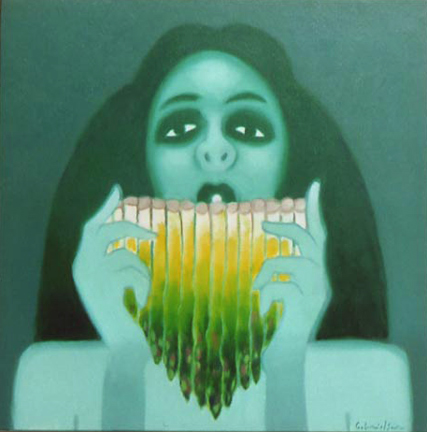
"She's a real mess. And a very bad mother I'm sure, that Anna Nicole. Very bad, indeed. So I don't know what everyone is crying about. Just look at her. What'll bring you to tears is when you see her kid, the poor thing. That child hasn't a chance. Well, not that anyone is doing a very good job these days, raising their kids, I mean. The kids on this block nowadays. They're starving! My kids, they may have grown into strange people - my little Sherry, for instance, she's all talk about veganism and gluten-free pumpernickel toast and asparagus. But when she was a girl, you bet as sure as Sunday dinner she was well-fed. We were a real family. Oh, we were as happy on Tuesday afternoon as we were on Saturday evening. And my husband, may he rest in peace, he was a good man. We used to take the kids to the movies. I'd get all dolled-up and look real nice. My husband would tell me 'Sandy, you're as perfect as a painting. You're a real woman with pearl earrings.' The kids would have on their nice clothes. We knew how to do things up. And on Sunday we went to church with a real pastor, not these 'spiritual healers' they talk about nowadays. We were good Catholics and we never heard a word about 'Scientology' or 'psychiatry.' We were just good hardworking people. Not anymore, not these kids. They don't stand a chance. Not with the way things are now - Pop Stars molesting kids right off the street. Did you know there's parents who don't even let their little one's celebrate Christmas? They're all talk about 'commercialism' and 'where our forefathers went wrong.' They all think they know better. All these ideas these young parents have today... But I don't say anything. Dean and I just sit on the front stoop and watch them go by. Because I had a good life, look at me. I'm as happy on Tuesday afternoon as I am on Saturday evening."

28.6.07

Neither House Nor Harbor

Genre: Lyric Essay

My mother’s kitchen is filled with smoke from bacon that is being cooked in heavy butter on a frying pan. She is outside calling at a dumb-brained dog that I brought home from the pound when I was sixteen without her permission. She is yelling at the dog from the back porch that overlooks the harbor. Upstairs is a twenty-five year old woman named Lilith who works at the local organic food coop. Lilith lays on her bed and rolls her eyes at the sound of my mother’s yelling. Below Lilith’s room is the kitchen. The kitchen is old and wooden with counter tops that slant downwards towards the floor, sagging with their age. My mother runs inside the house, the dog following behind her with a grin on his face and mud on his paws.

The smoke rises from the pan and drenches the lace curtains, which have slowly turned yellow. Sunday after Sunday my mother cooks bacon in the pan, which is black from Sunday after Sunday’s worth of butter and bacon being left too long to cook. Sunday after Sunday the lace curtains are drenched in the smoke from the bacon. My mother scuffles into the kitchen and grabs a blue-and-white-checkered cloth and swoops up the pan, landing it on the butchers block counter. The bacon continues to sizzle as the butter slides across the pan with the slope of the counter top.

My mother turns around and bumps into the dog. When she looks down at him she sees his muddy paws and begins squawking at the trail of prints he has left behind him on the pine floors. She shoos the dog back out the door, waving the cloth at him as he cringes at her squawking. She bends over and attaches him to a leash that is tied to a post that holds up the porch roof. The porch roof is also sagging with age. The entire house looks as though it is melting.

Inside is the dining room, which is next to the kitchen where the bacon has stopped sizzling but continues to smoke below the lace curtains. In the dining room there are piles of magazines that my mother reads on Sundays as she eats her bacon and biscuits. Three years worth of The New Yorker spill from the wooden bookshelf that sits next to a down-stuffed chair where my mother does her reading. My mother runs back inside, not noticing that the kitten that belongs to Lilith, the woman who lives in one of the house’s three bedrooms, has ran out the door and into the yard behind her. She goes back into the kitchen waving at the smoke with the blue-and-white-checkered cloth.

Billy Holiday’s voice bellows from the stereo in the dining room. The volume of the music drowns out the sound of knocking on the front door. As the song ends my mother hears the knocking and scuttles from the kitchen, through the dining room and into the living room where she sees Levi on the front porch. Levi lives in the second spare bedroom and he has forgotten his keys. Lilith comes downstairs when smoke from the bacon has crept up the stairs and fills her room. Lilith is a vegan and hates when my mother cooks bacon on Sundays. Levi storms past my mother, who is blocking the stairs and past Lilith who is coming down the stairs. He runs up the stairs to get his keys. He is late to get to work at the wood shop where he works restoring antique sailboats.

I am on the phone with my mother as all this happens. I have never been to see her house on Squirrel Island. She moved there three years ago and rents out her spare rooms to young people because she 'can’t live with too much silence.' I have spent the last ten minutes listening quietly from my bed in my loft, a converted warehouse in in Bushwick, where my roommates are either not home or still sleeping. There are three of us living here and I have not seen anyone in three days.

I am listening to my mother mutter cheerfully through the phone about how much she loves Sundays – about how much she loves having a house filled with people – about how the dog loves living by the harbor where he can go on walks without a leash – about how Levi is helping her find a sailboat to buy before the summer – about how Lilith hates when she cooks bacon – about how the kitten and the dog are getting along – about how the lace curtains in the kitchen are turning yellow – about everything, until the three of them, my mother, Lilith, and Levi, collide at the staircase, which is now filled with smoke from the bacon and butter.

Lilith asks where her kitten is. Levi yells from upstairs asking if anyone has seen his keys. My mother says she must get off the phone ‘Levi lost the kitten’ she says ‘and Judith can’t find her keys – oh, and I think the bacon is still on the stove.’ I try to engage in some sort of formal good-bye but find the line dead before I can speak the words. I hang up the phone an turn into my pillow which is yellow because of one summer's worth of sweat and my hatred towards the long, quiet walk to the laundromat. My neck is damp and hot, though the fan is directly beside me. It doesn't cool my neck, just moves the warm air of my room which has no windows to the outdoors, just two squares cut into the top of the wall which look into the living room. The living room windows look into an alleyway. The alleyway looks down.

25.6.07

Art & Mimi


Photograph by Ax.Rok

The Desk Dream

Genre: Lyric Essay

I, like you and any other attentive person, hear a good deal of interesting things day to day. Some are more interesting than others (last January during a horrible storm my building's super told me that more than 10% of the world's salt is used to de-ice American streets and sidewalks). And some are not interesting at all (the dull-voiced boy at the market loves to remind me that 'Eggplants aren't vegetables, they're really fruits,' which, I'll add, I'm not sure is true). Like most attentive people, I have forgotten a great many of the interesting things I've heard. Often times, the less interesting things pass through my mind as I lay in bed at night trying earnestly to recall the interesting things. That is how it happened I came to fight Virginia Wolfe (oh yes, I know - how boring).

Did you know, Virginia Wolfe once mused on her life? I'm sure you did. What I mean to say is there was a time before the river. Before her mind had come to questions like, how heavy a stone to sink a woman my size? (large, but small enough to fit in the pocket of her coat). Yes, she wrote of her life without considering her sort of mortal end. She wrote of how she imagined her life in furniture form (with corners and shelves).

She imagined her life being a great big desk, or so she wrote.

This is not an entirely interesting thing. A desk, holding papers, dripping candle wax and bleeding ink from it's oaken pores, like her (oh that drama queen, the Sinking Princess). And it was this less than interesting thing - a relatively dull musing (The Desk's) and my musing upon it that brought her to my dream.

Many have told me not to bore others (and I suppose myself) with writings about dreams and meanings. I rarely take notice of what other advise and will do just half of this. I will tell you of the dream and spare you the meaning (anyhow, you'd be at a loss, I'm sure). Nonetheless,

Because I am too late (too young and have seen The Hours) Virginia (The Desk) looked much more like an actress playing herself (Virginia 4.0, not Nicole Kidman - no prosthetics, but a cheaper, softer version - yes).

As I lay in bed thinking of her, I asked myself... would you (me, the dreamer) be a desk? and falling asleep I answered,

*

Why, yes. What a desk I'd be. I'd be wanting. If I were a desk I’d be wanting to be a bed. And I agreed. That is, before she came hammering. Yes, Virgina came to my door. I opened it and thought: Virgina's fist are peculiar little acorns, and turned to see her rattling the windowsills of my apartment.

'All in the name of! All in the early hour of!' I screamed (which, in a dream, sounds like a scream but underwater) .

'All in the name of misinterpretation,' she said. She continued, 'you've misinterpreted me.' And I told her, 'I am bored with you, Pestering Woman.’

'What did you say?' - Her question.

And my unexpected answer was to let her in, and sit her on my couch. I reminded her that she knew boredom well. I reminded her that she understood bitterness, like mine. I told her I was bitter with her for stealing all my short paragraphs, for taking out narrative and filling it in with tea parties and ‘I’ll get the flowers myself.’

(It’s an awful thing to quote an author in your coy assault on them) And when she bit her lip and turned to the side, I saw her then an awkward girl. Not -The Desk- but more The Cafeteria table. She slumped beside me, and I pressed my thumb on the nape of her neck. And then (with something like a sniffle, but in poetics and with rhyme) she said:

‘If you, The Dreamer, were a book it’d be Kundera’s' (somehow she knew I hated that book). I stopped and thought of Prague (it's not really pink, you know). I grew angry. How dull. Unbearable Lightness, a sham. I yelled.

'Life and death, I?'

'Heaviness and Lightness, I?'

'From first to last?' and I put my index finger over her mouth.

‘You're nothing but a shallow conflict. ’ she went on ‘The reader, left to try,to decide which life is happier: light or the dark? grace or weight?’

'What is so unbearable about lightness, Fickle Heart?' she asked.

Only she doesn't (didn't, or never did) know the charm, that Virgina, that smoked-fruit. She was never light. She could only write with lightness. And even then she wrote of flowers so as to describe the grey hallways in which they sat.

*

And then, that falling feeling. From the bed to awake as loud as the alarm clock stops. And I was awake – awake and with the the realization that, with no hope of knowing the right, the shady pathways from the wrong, there is no wrong path.

Absolved of mistakes. The necessity of significance. And she wasn't there in my bed (because then was a dream and now was awake). I thought of Virgina and her sense of weight, a stone in her coat. Because what happens once never happened. And I fell back asleep with no stone in my pocket. It did not happen once for her, but over and over until her final waltz into the currents that be. And now here I am, telling you (in some detail) about this less than interesting thing, a dream about Virgina Wolfe. But I will not tell you the meaning. That would be boring. Which is, of course, to assume you are like those who advise not to write of dreams - those stubborn minds who have yet to realize that the dream is the meaning as soon as one tells it to a third party. That is to say all this really means is I'm the sort of person who dreams about The Desk.

20.6.07

Limp

“Unlike femininity, relaxed masculinity is at bottom empty, a limp nullity. While the female body is full of internal potentiality, the male is internally barren. Manhood at the most basic level can be validated and expressed only in action.”-George Gilder

13.5.07

Today (Ways of Thinking)


Genre: Lyric Essay

Today you wake up and feel limited. You are unable to locate the exact reason why you feel limited. Perhaps this sentiment of limitation came from a dream you had while you slept in which you felt limited. No matter the reason, the idea of limitation is in your mind as you are stirring. Limitation is a heavy thing, you think to yourself – like a mattress being carried up a narrow staircase. You imagine yourself carrying a heavy mattress up a narrow staircase. You feel limited.

(Redundancy, doing things over and again, is inescapable. Each day is inevitably similar to the one before it. This is how one lives. One makes decisions, silly ones, superficial even - to buy a shirt, a green shirt. And we feel things have changed. Because one does not buy a new, green shirt every day. The outcome of the action is lasting. Even after the tag is removed, the smell of new seeps from the threads and into the air, the shirt becomes the color we always wear. It's fabric becomes our skin, the texture our lover's fingers recognize at a slightest graze. We forget that the shirt was ever new; that it once marked a begining. And so the challenge is to reconsider, to reexamine – to find a begining, a new way of thinking. For example: one discovers one can be aware of words. One discovers that one’s emotions are not limited to emotions, but to particular words. One can experience one’s day guided by the word. The word can be used as a lens. One can look through the lens of that word for one’s entire day.)

Today you decide to explore the word limited. Still, you must dress yourself. You rise from your bed and walk to your dresser. You open the drawers of your dresser and look at your clothes. In your dresser are the clothes you have always worn. You look at your choice of shirts. You stand over them and stare. You own so few shirts. You feel limited by the options you have given yourself. There are shirts with short sleeves in your dresser. There are also shirts with long sleeves. You do not own shirts that have three-quarter length sleeves. You are limited to either short sleeves or long sleeves. But you must choose a shirt to wear. You choose a shirt with short sleeves because you are limited to either short sleeves or long sleeves and you must choose one.

Now you must choose the color of the shirt. You are limited to the colors you have always worn. You have always worn green shirts and brown shirts. You do not own a red shirt. Still, you must choose what color shirt to wear. You choose a green shirt because even though you are limited, you are still forced to choose a color. You think to yourself: getting dressed is a limiting thing. Limiting things are colors and sleeves.

(The discovery that one can live by the definition of can be frightening. One thinks it might be simpler to buy a new shirt. But shirts have been bought and nothing has changed. A new way of thinking ensures change. One hesitates at employing this way of thinking. However, this way of thinking can be an experiment that stimulates one’s interest in once ordinary things. One navigates situations using the word as a lens through which one looks one’s world.)

You leave your house and you are still feeling limited. Still, you must leave your house to get coffee. There is only one coffee shop in your neighborhood. You feel limited because of the lack of coffee shops in your neighborhood. You stand outside your house and look at the streets. There are only two streets you can take to get to the coffee shop. And to get to the coffee shop you must choose one of these streets. You feel limited by the streets you can take to get to the only coffee shop in your neighborhood. You feel limited because there are only two routes to take to get to the coffee shop. Yes, you can walk out of your way and thusly have a third route. But you are not interested in walking out of your way. If you walk out of your way, you will be late to meet the friend that you made plans to meet after you get your coffee. You are not interested in making yourself late. You are interested in getting coffee. You can only walk down one street or the other street. You choose one street because, though you are limited to these two streets, you must choose one of these streets in order to get to the coffee shop. Walking to the coffee shop is suddenly a limiting thing.

As you walk down the street you consider this notion of limitation. If you had a dictionary you would look up the definition of limitation. You do not have a dictionary. You only have your notebook. You imagine how limitation might be defined: the quality of being limited? No, that’s not right at all. You are frustrated by your inability to define a word that haunts you so deeply.

(As one descends into this way of thinking, there is a blissful moment in which one lets go. One lets go of the way one thought in the past. This new way of thinking is new and one wishes desperately for something new. Redundancy is suddenly escapable. And while this new way of thinking is new and therefore unknown to be a good way of thinking, one rests assured that one is capable of retreating to past ways of thinking. There is a narrative one keeps. The narrative speaks the thoughts of the past. It tells one that one knows what one is doing – that one can retreat from this way of thinking and process things as one once did. But the prospects of a new way of thinking are exciting. One goes on thinking in the voice of the new.)

You get to the coffee shop and you are feeling limited. Still, you must get coffee. You enter the coffee shop and look at the menu. You put your hand in your pocket, the place where you keep your money. You remove the money you keep in your pocket. Today you only have enough money for a small coffee. You cannot afford a large coffee. You feel limited by the options of coffee you can afford. On the menu there are only two variations of small coffee. There is decaf coffee without caffeine. There is regular coffee with caffeine. You can only afford to choose between these two options. You chose regular coffee because there are only two options and you must choose one. You pay for your coffee. Now you must choose a creamer. The creamer that coffee shop offers is free. But they only offer you two kinds of creamer. There is heavy cream and there is light cream. You are limited to heavy or light. You choose light because you are limited these two options and in the past you have always chosen light cream in your coffee. Drinking coffee is a limiting thing when you only have enough money for a small coffee and creamer comes only in heavy or light.

(The word, which is now a lens through which one looks, can be put to everything. This is more than can be done with a shirt. Everything one does becomes in relation to the word. When this notion is conceived, one conceives the secondary notion that the word can be applied not only to the present, but also to the past. One examines the past looking through the word which is now a lens.)

You sit down at a table in the coffee shop and feel limited. Still, you must write. You are a writer. But you feel limited by the words you can write. You open your notebook and read the words you have written in the past. You feel limited by the way you have always written. There are happy words. There are sad words. The happy lines in your notebook are dotted with words like love and epiphanic and consistency. The sad lines contain the word love as well, but the word is paired with words like dispiriting and constraint. You feel limited by these words. It seems you are limited to writing either happy words or sad words. But you must choose something to write. You choose to write sad words because you are limited to sad words or happy words and this idea of limitation is starting to make you sad. You see no other option – you feel limited by this sadness. Words can also be limiting things.

(It becomes a dangerous thing to look at the past through this word which is now a lens. The danger is that the past, the time when one was not examining things in relation to this word, seems meaningless because it was undefined and without the lens that one now finds so important. Again, there is the shirt, the shirt one has always worn. Alarmed by the possibility that one’s past is meaningless – one averts ones view and uses the lens to examine the future. The future is filled with others. And others can be examined through the lens.)

You leave the coffee shop and feel limited. Still, you must meet with your friend. You have made plans to meet your friend. You have not made plans to do anything else. So, you go to meet your friend. There are two things you have always talked about with this friend. You have always talked about writing and art. When you start the conversation you must decide between talking about writing or talking about art. You feel limited by the things you can talk about with your friend. You meet your friend and begin talking. You choose to talk about writing because you are limited to talking about either writing or art. And now that you have begun talking about writing, you realize that there are only so many things about writing you can talk about. You talk about your experience today and how you discovered that words are limiting. You feel limited by this conversation. Talking to your friend is a limiting thing.

(One inevitably becomes tired of the word one has used as a lens through which one has examined one’s world. Sleep becomes a possibility of clearing one’s mind of the word. One can wake up and find a new word, a new way of thinking.)

You end the conversation with your friend and feel limited. Still, you must go home and take a nap. You must take a nap because you are tired. You go home to take a nap. In your house are the two places where you have taken naps in the past. There is the couch where you have napped. There is also the bed where you have napped. You feel limited by the places where you have taken naps. You choose to nap on bed because you are limited to taking a nap on the couch or taking a nap on the bed. You must choose between the two, and so you choose the bed. Taking a nap is a limiting thing. As you fall asleep you ponder the notion of limitation. You rise and find the dictionary that you did not have with you on your way to the coffee shop. You find your place back on the bed and look up the definition before you fall asleep: an imposed restriction that cannot be exceeded or sidestepped.

Today you wake up and feel filled with possibility. You can do anything you want. This feeling is to be filled with possibility. You decide to dress yourself, though it is possible to stay naked in bed where it is comfortable and warm. But, you feel a tremendous sense of possibility in the options of what you might do today.


(One has escaped the word one has used as a lens. But the notion that one can be guided by a word and the emotion attached to that word becomes a notion filled with unlimited possibilities. There are many words. There are many ways of thinking. This notion is paired with the notion that one can decide upon the word one uses as a lens through which one examines one’s world. Because one possesses the capability of choosing the word, one feels in control. One no longer feels limited.)

You open the drawers of your dresser and look at your clothes. In your dresser there are the all the clothes you can possibly wear. You feel a sense possibility in the options you have given yourself. You look at your choice of shirts. There are shirts with short sleeves. There are shirts with long sleeves. It is possible to choose to short sleeves or long sleeves. You choose a shirt with short sleeves because you have the option to wear either short sleeves or long sleeves. These are two very different possible shirts to wear. Now you can choose the color of your shirt. You have the possibility to choose between the colors you have always liked. You have always liked the colors green and brown. You choose a green shirt because you have the option to choose between green and brown. Today you feel like wearing green. You love the color green. But it is possible to wear brown. Getting dressed can be filled with possibility.

You leave your house feeling anything is possible. You decide to get coffee. You leave your house and look at the streets. You feel a tremendous sense of possibility in the routes you can take to the coffee shop. There are two possible routes you can take to get to the coffee shop. You feel a sense of possibility because anything could happen on those two routes to the coffee shop. You can walk down one street or the other street. You choose one street because you are excited by the many possible things that might happen on that street as you walk to the coffee shop. Walking to the coffee shop is filled with possibility. You consider the word possibility: something that is possible. The definition is small and precise and you remember it in full without the need of a dictionary.

You get to the coffee shop and you feel anything is possible. You enter the coffee shop and look at the menu. You decide to get coffee, though it is possible to get tea. You feel possibility in the options of coffee you can drink. On the menu there are two kinds of coffee you can afford. You feel possibility in the options the coffee shop has given you. There is decaf coffee without caffeine. There is regular coffee with caffeine. You chose regular coffee because you possess the ability to choose the kind of coffee you want to drink. When you choose regular coffee you chose the possible end result of being more energetic with the aid of caffeine. Now you can choose a creamer. There is a heavy cream and there is a light cream. It is possible to choose between heavy or light. You choose light because you prefer light cream in your coffee, though it is possible to choose heavy. Drinking coffee is filled with possibility.

It is exciting that one can navigate one’s day, looking at the world through such a positive lens. One has become increasingly able to use this lens to examine one’s world. Gone are the doubts one ever had that this way of living was remotely dangerous or questioning of the past. The past (the time when one chose to examine the world through a word like ‘limitation’) is a marker of the time when one chose the wrong word to examine one’s world. One now sees one’s own capability in choosing a word which is now a lens.

You sit down at a table in the coffee shop and feel anything is possible. You decide to write in your notebook, though it is possible to draw in your notebook. But you are a writer. You feel a tremendous sense of possibility in the words you can write. You open your notebook and look at the words you have written. In your notebook are the words you have written in the past. You see the ways you have written in the past. There are happy words. There are sad words. Today there is the possibility to write different kinds of words. You choose to write sad words because you are excited by the many possible ways to write sad words. Words are filled with possibility.

You leave the coffee shop and feel anything is possible. You decide to meet up with a friend, though it is possible to go to the park. But you feel excited by the things you might talk about with your friend. You meet your friend and begin talking. There are two things you have always enjoyed talking about with this friend. You have always enjoyed talking about writing and art. When you start the conversation you decide to talk about writing. You choose to talk about writing because you have discovered a new way of writing sad words and it is possible your friend will have exciting insight to this new way of writing. Talking to your friend is filled with possibility.

You end the conversation with your friend and feel anything is possible. You decide to go home and take a nap. You go home to take a nap, though it is possible to go somewhere else. In your house are the places where you have taken naps in the past. There is the couch where you have enjoyed napping. There is the bed where you have also enjoyed napping. It is possible to take a nap in these two places. You choose to nap on the bed because it is possible that you might sleep very well on that bed. It is possible you might have a very nice dream should you nap on the bed. Taking a nap is filled with possibility.

Today you wake up and feel indifferent. You suppose you should dress yourself. You understand there are options in what you can wear, but you do not care. You open the drawers of your dresser and look at your clothes. In your dresser there are the all the clothes you can possibly wear. You understand this possibility. You have, after all, allowed yourself these options.

(The descent into this way of thinking has gained momentum. Choosing the word which one makes one’s lens through which one examines one’s world becomes a task which one has little control over. One merely awakes with a word in one’s head and one cannot seem to escape the word, as the word is in one’s head as one was sleeping and one cannot clear the word from one’s head as one awakes. Furthermore, the past narrative, the narrative that reassured one that there was a way of retreating from the way one thinks becomes less clear. One is no longer reassured by the past – the time when one did not choose a word which one made one’s lens, and past narrative, which is neither conscious nor unconscious, begins to sound incredibly more like the present narrative, which is entirely conscious.)

You look at your choice of shirts. There are shirts with short sleeves. There are shirts with long sleeves. You are indifferent on whether you should wear short sleeves or long sleeves. You choose a shirt with short sleeves because you are somehow indifferent about wearing either short sleeves or long sleeves. And now you realize you must choose the color of your shirt. In the past you have liked the colors green and brown. Now you must choose between wearing the color green or the color brown. You cannot wear both shirts. You choose a green shirt because you are indifferent to these two colors, even though they are the ones you have liked in the past. In the past you very much liked wearing green. Today you are indifferent to the color green. So you chose to wear green based on the fact that you have liked it in the past. Getting dressed is something to which you are indifferent.

You leave your house feeling indifferent. You suppose you should get some coffee. You leave your house and look at the streets. There are two possible routes you can take to get to the coffee shop. You are indifferent to the routes you should take to the coffee shop today. You feel indifferent because nothing that exciting could happen on those two routes to the coffee shop. You can walk down one street or the other street. You choose one street because you are indifferent to which route should take to the coffee shop. You just want some coffee. Walking to the coffee shop something to which you are entirely indifferent.

You get to the coffee shop and you are indifferent. You enter the coffee shop and look at the menu. You decide to get coffee, but not because you particularly want it anymore. You are indifferent whether or not you should even drink coffee. On the menu there are two kinds of coffee you can afford. There is decaf coffee without caffeine. There is regular coffee with caffeine. You don’t really care either way. You choose regular coffee because you are relatively indifferent to the kind of coffee you want to drink. Now you can choose a creamer. There is a heavy cream and there is a light cream. You have no stance on whether you should add heavy or light cream to your coffee. You’re not even sure you want coffee. You choose light because in the past you have preferred light cream in your coffee, though today you don’t really care about coffee or what kind of cream is in it. Drinking coffee is something to which you are indifferent.

(The danger in the technique one has adapted in examining one’s world is that one loses one’s ability to remember that one once went about one’s day without using a word through which one examined one’s world. Examining is not what one does with the word one once chose as a lens. Rather, the word one chosen becomes darkened and one can’t see through the word that is now a lens, a very dark lens. The word itself is now one’s world. One’s world becomes a word from which one cannot escape.)

You are feeling a bit indifferent on what to do today and so you sit down at a table in the coffee shop. You look out the window. Outside the coffee shop is the street. You are not interested in what is happening on the street so you decide to write. You are a writer. You consider the things you can write about. You are unsure of what you feel like writing. You open your notebook and look at the words you have written in the past. You read the words you have written in the past. There are happy words. There are sad words. Today you are unmoved to write different kinds of words. You choose to write sad words because you are indifferent to words and writing and you merely write because it distracts you from the fact that you really do not care about anything or the words that can be used to describe it. Words don’t make a difference.

You leave the coffee shop feeling it does not make a difference where you go. You remember though, that you made plans to meet up with your friend. At present you don’t care about meeting up, though apparently at the time you made these plans you were intrigued by the things you might talk about. You meet your friend and your friend begins talking. Your friend is always asking you questions about writing and art. You have always humored your friend by talking about these two things, though you are truly indifferent. When your friend starts a conversation about writing, you are not surprise nor do you care. You talk about writing and how it doesn’t make a difference what anyone writes. Talking to your friend is filled with possibility.

(Finally, one becomes confused by the way one is thinking and since one is not in control of the way which one is thinking, one becomes entirely controlled by the words which one made one’s lens. One’s past lens and one’s present lens which is also one’s narrative – a narrative to which one is both conscious and unconscious, one gives into the words and the words give into their meaning – becoming blurred and interchangeable.)

You end the conversation with your friend and feel the conversation didn’t make a difference. You decide to go home and take a nap. You go home to take a nap, though it is possible to go somewhere else. In your house are the places where you have taken naps in the past. There is the couch where you have been limited to napping. There is the bed where you have also enjoyed napping. It is impossible to take a nap in these two places. You choose to nap on couch because it is indifferent that you might sleep very well on that possible couch. It is possible you might have a very indifferent dream if you nap on the limited couch. Taking a limited nap is filled with indifferent possibility.

(One rests. One awakes. One sees things differently. And that was one's hope with this new way of thinking.)


painting by ariel churnin